
NUMEROLOGY
History of Numerology

FOR VAASTU INTERNATIONAL COURSES - CLICK HERE
The history of numerology is somewhat cloudy with no definite answer as to where it first originated. Egypt and Babylon are recognized as the earliest recorded history of numerology by the majority of numerologists. It was here that the Chaldean system was developed under the influence of the Hebrews. There is also evidence of the use of numerology thousands of years ago in China, Rome, Japan and Greece. The credit for modern numerology, however, is most often given to the Greek philosopher Pythagoras.
FOR VASTU NUMEROLOGY COURSES - CLICK HERE
FREE ONLINE VASTU SOFTWARE - CLICK HERE
FREE ONLINE MOBILE NUMBER NUMEROLOGY CALCULATOR IN HINDI - CLICK HERE
FREE ONLINE MOBILE NUMBER NUMEROLOGY CALCULATOR - CLICK HERE
FREE ONLINE LO SHU GRID CALCULATOR - CLICK HERE
FREE ONLINE LO SHU GRID (HINDI) CALCULATOR - CLICK HERE
FREE ONLINE VASTU NUMEROLOGY SOFTWARE - CLICK HERE
FREE ONLINE NUMEROLOGY CALCULATOR - CLICK HERE
FREE ONLINE HINDI NUMEROLOGY CALCULATOR - CLICK HERE
FREE ONLINE NAME NUMEROLOGY CALCULATOR - CLICK HERE
FREE ONLINE DESTINY NUMBER CALCULATOR - CLICK HERE
FREE ONLINE KUA NUMBER CALCULATOR - CLICK HERE
FREE ONLINE CHINESE ASTROLOGY SOFTWARE - CLICK HERE
FREE ONLINE TATOT CARD SOFTWARE - CLICK HERE
FREE ONLINE INDIAN ASTROLOGY SOFTWARE - CLICK HERE
FREE ONLINE DAILY PANCHANG CALCULATOR - CLICK HERE
FREE ONLINE LAL KITAB PRASHNAVALI - CLICK HERE
FREE ONLINE NAKSHATRA AND RASHI CALCULATOR - CLICK HERE
Pythagoras was born is Greece around 590 BC and was one of the best known philosophers of his day. If his name sounds familiar it is likely because you were taught his theories in high school geometry class. He was a very important figure in the development of mathematics, although little is known about his true achievements.

There is very little recorded of the early life of Pythagoras, but it has been reported that he was a very magnetic, attractive, charismatic person and that everyone loved him. He is also believed to have won prizes for his agility at the Olympic games.
When Pythagoras was around 50 years old he established a school that was sort of a secret society in Crotona, Italy. The society was called the semi-circle and there he taught Mathematics, Astronomy and Music. The society was open to both men and women. and it is said that his students were made to adhere to a strict code of secrecy and were not allowed to put any of his teachings in writing. It has also been reported that his students had to go through a 5 year period of perfect silence which allowed them to reach a level of deep contemplation and to develop faith. Most of the little that is known of what he taught was written down after his death.
Rather than focusing on solving mathematical problems like modern day mathematicians, Pythagoras was primarily interested in the concepts or principles behind the mathematics. He felt that the entire universe could be expressed through numbers, and created a system for this that was then further expanded by other Greek philosophers. Although Pythagoras did not invent numerology, his theories took it to a different level which is why he is often credited with being the father of numerology.
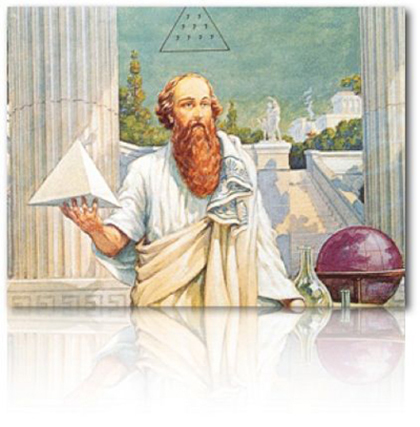
Although the exact origin of Numerology hasn't been truly determined, there are strong clues. The Pythagorean and Chaldean schools of numbers are the most commonly used. Chaldean Numerology is older, but the Pythagorean system of numbers is far more popular especially in the west.
Pythagoras was considered a master mathematician. Born in Greece in the 6th century B.C., he demonstrated a natural gift with numbers. Many people are familiar with his theorems in geometry. However, he is also considered to be the Father of Modern Numerology. It has been recorded that he spent many years of study in Egypt and other parts of the world learning the ancient science of numbers. He later brought this knowledge back to Greece, where he taught for nearly forty years, and established a college and philosophy of numbers that would bear his name to this very day.
It was said that Pythagoras taught in secret. That each student, selected with care, had to go through a five year period of perfect silence for the purpose of contemplation to develop a deep sense of faith. Furthermore, his students had to commit his teachings to memory, for it was forbidden to put any of it in writing. It was only after his death, around the year 500 B.C., that his faithful followers broke with this tradition.
The Chaldean system of numbers better known as Mystic Numerology gives us an even stronger clue to the age of this science. Astrology, Numerology, and other occult studies were considered a religion, but not in the way we would know it today. Many Chaldean priests were also famous astrologers. They held the belief that all things were part of Divine Providence, and that the planets were simply heavenly interpreters. In the time of Alexander the Great, around 356 B.C., the Chaldean believed that their knowledge of Numerology and Astrology went back at least 473,000 years. Perhaps it was no accident that, in time, Chaldean and the occult became synonymous. The Chaldean system of numbers is still in use today.
Difference Between Chaldean and Pythagorean Numerology -
These are some contrasting characteristics between Chaldean and Pythagorean numerology.
- Historical differences: Chaldean numerology is older than Pythagorean numerology. It is credited as being formulated by the ancient Babylonian empire over 5000 years ago. Each numerology system was set up in a different era, motivated by diverse beliefs.
- Use of the number 9: Pythagoras uses 9, but the Chaldean’s system does not.
- Arrangement of numbers: Pythagoras system arranges the letters A to Z in it's chart sequentially. The Chaldeans arrange A to Z against numbers based on their vibrations (sound).
- Name changes: The Chaldean’s make room for name changes, Pythagoras does not.
- Interpretations of numbers: Each system has different interpretations of numbers.
- Allowance for double digits: The Chaldeans use double-digit numbers, but Pythagoras system concentrates mainly on reducing all numbers to single numbers.

Indian Vedic Numerology -
Numerology is a science of exploring hidden powers of numbers and their influence on human beings.
Indians see numbers as symbols of certain types of cosmic powers and they link them with spirituality. For example 0 is a number that encircles some part of the infinite universe. The inner part of it is separated from the vast outer space. This is similar to human body where the soul (Jeevaatma) resides. A human being always feels that he is separate and the outer universe is different from him. He confines his soul with his present body and thinks that he and the body is one and the same. Thus he has forgotten the truth that he is the all-pervading God. This is called cosmic delusion (Maaya). So 0 represents the cosmic delusion. This means 0 gives false impression that what ever is not there, is there. Let us add 0 after 1, then that 1 appears as 10. This means 1 is assuming a different form, because of 0. This is same as the super-soul appearing in different forms because of Maaya.
Every number will have mental and spiritual plane represented by it's top half part and the material worldly affairs are represented by it's remaining bottom part.
When we connect a series of points in a single direction, then it becomes 1. Thus 1 represents single-mindedness in achieving the objectives, creativity and starting new ventures. It's pillored appearance represents independence and leadership qualities.
2 is round shaped at top. It is a open 0. That means there is no complete Maaya at mental level. There is a scope to receive and release new ideas and concepts. So 2 represents flexibility and diplomacy. The bottom of 2 shows a horizontal line that is attached firmly to ground. This means if these inventive ideas are properly used, the person can achieve highest success in material world.
Take 3, it is having open rounded ends at it's top as well as at bottom. This shows continuous receiving and releasing of new ideas and involving into new developments. It represents ambition, self-expression and idealism. This number makes a person to reap material benefits from his intelligence and spiritualism.
Just close the rounded ends of 3, you will get 8. It represents Maaya at both the levels. The person is wrapped by complete ignorance of what is happining outside his perception. He cannot come out of the clutches of karmic forces. The balanced loops of 8 represents balanced nature, patience and discipline.
Contemplete on 4, it is looking like a person sitting stable, attached to ground. The triangle above represents fire that promotes a strong desire for material benefits. The person will become materailistic. 4 may also represents unconventional behaviour.
5 is a quiet different number, with flat head and open rounded bottom. Flatness represents stability. The person would reach a clear and stable mental state which he uses in receiving and processing the material in worldly projects. 5 is a sign of dynamism and communication. This number makes one a successful business man.
7 is having similarity with 5, in such a way it is having a flat head and weak base. 7 indicates high level of spiritualism and sensitivity. But the person will not use his mental and spiritual stability to achieve material means.
6 is a number that is fully rounded at the bottom. It looks like a pregnant lady. It symbolises pregnancy, artistic and feminine qualities. The 0 formation at bottom indicates Maaya that pushes the person in love with family related matters and enjoyment.
9 is a number that is nothing but inverted 6. It represents love to the world. The 0 formation at top, overshadows a person's intelligence with Maaya. The person cannot think but work. So there is a conflict. He would be quick in actions and courageous.
While the numbers have the above significance, each number has been attached to a particular planet in Astrology, the reason is: cetain planet produces the similar vibration of a certain number. Thus 1 - Sun, 2 - Moon, 3 - Jupiter, 4 - Uranus or Rahu, 5 - Mercury, 6 - Venus, 7 - Neptune or Kethu, 8 - Saturn, and 9 - Mars. Number 0 should not be attached to any planet, since it is the root cause of all the numbers. It increases the strength of a number.
Yoga Poses Aligned with Your Numerology Number
Yoga Poses as per Numerology Number:
Let’s explore the yoga poses aligned with each numerology number:
Numerology Number 1:
Individuals with numerology number 1 are natural-born leaders with solid willpower and independence. To enhance these qualities and find balance, they can benefit from yoga poses that activate their core and build confidence.
Yoga Poses:
Warrior I (Virabhadrasana I) – This pose cultivates strength and determination while grounding the individual in their power.
Boat Pose (Navasana) – Stimulates the core muscles and strengthens the person’s willpower.
Mountain Pose (Tadasana) – A foundational pose that promotes stability and self-assurance.
Numerology Number 2:
People with numerology number 2 are compassionate, harmonious, and nurturing individuals. They can focus on yoga poses that promote balance and foster a sense of connection to enhance their natural traits and achieve inner peace.
Yoga Poses:
Tree Pose (Vrksasana) – Encourages balance and harmony while improving focus and concentration.
Child’s Pose (Balasana) – Facilitates a sense of surrender and nurturing, allowing them to connect with their inner selves.
Partner Yoga Poses – Partner yoga fosters a more profound sense of connection and empathy.
Numerology Number 3:
Those with numerology number 3 are creative, expressive, and vibrant beings. They can incorporate yoga poses that promote self-expression and joy to tap into their artistic energy and maintain a positive outlook.
Yoga Poses:
Camel Pose (Ustrasana) – Opens the heart and throat chakras, enhancing creativity and communication.
Dancing Warrior (Natarajasana) – Encourages self-expression and grace, embracing the spirit of dance.
Laughter Yoga – A playful practice that combines yoga with laughter to boost positivity and creativity.
Numerology Number 4:
Individuals with the numerology number 4 are practical, reliable, and disciplined. They can incorporate yoga poses that promote stability and discipline to enhance their grounded nature and find inner strength.
Yoga Poses:
Warrior II (Virabhadrasana II) – Strengthens the legs and enhances focus and endurance.
Plank Pose (Kumbhakasana) – Builds core strength and fosters discipline in practice.
Seated Forward Bend (Paschimottanasana) – Encourages introspection and discipline, promoting a sense of groundedness.
Numerology Number 5:
People with the numerology number 5 are adventurous, curious, and adaptable. To embrace their adventurous spirit and maintain a sense of calm, they can focus on yoga poses that foster adaptability and freedom.
Yoga Poses:
Half Moon Pose (Ardha Chandrasana) – Challenges balance and encourages adaptability in movement.
Pigeon Pose (Eka Pada Rajakapotasana) – Releases tension and encourages physical and mental flexibility.
Vinyasa Flow – A dynamic and creative style of yoga that aligns with its versatile nature.
Numerology Number 6:
Those with numerology number 6 are nurturing, loving, and compassionate individuals. To embrace their caring nature and find emotional balance, they can focus on yoga poses that open the heart and promote self-love.
Yoga Poses:
Cobra Pose (Bhujangasana) – Opens the heart chakra and encourages self-compassion.
Bridge Pose (Setu Bandhasana) – Releases tension in the chest and promotes feelings of love and acceptance.
Loving-Kindness Meditation – A practice of sending love and compassion to oneself and others.
Numerology Number 7:
Individuals with the numerology number 7 are introspective, spiritual, and wise. They can focus on yoga poses that facilitate meditation and self-awareness to deepen their connection with the spiritual realm and find inner peace.
Yoga Poses:
Lotus Pose (Padmasana) – A traditional seated pose that promotes a sense of calm and serenity for meditation.
Supported Headstand (Salamba Sirsasana) – Inversion poses like headstands facilitate a deeper connection with the self.
Yoga Nidra – A guided meditation practice that induces deep relaxation and heightened self-awareness.
Numerology Number 8:
People with the numerology number 8 are ambitious, confident, and determined. They can focus on yoga poses that promote grounding and ambition to channel their drive and find a balance between material and spiritual pursuits.
Yoga Poses:
Warrior III (Virabhadrasana III) – Builds focus and balance while promoting determination and ambition.
Standing Forward Bend (Uttanasana) – Helps release tension and ground the person, allowing them to stay focused on their goals.
Abundance Meditation – A practice to attract abundance and prosperity into their lives.
Numerology Number 9:
Those with the numerology number 9 are humanitarian, compassionate, and wise souls. They can focus on yoga poses that foster a deeper connection with the world and those around them to enhance their spiritual wisdom and continue their journey of selflessness.
Yoga Poses:
Extended Triangle Pose (Trikonasana) – Creates a sense of expansion and connection with the universe.
Fish Pose (Matsyasana) – Opens the heart and encourages a sense of compassion and understanding.
Gratitude Meditation – A practice that fosters gratitude and selflessness.
Conclusion:
Incorporating yoga pose that align with your numerology number can be a powerful tool for enhancing your spiritual journey and overall well-being. By acknowledging the unique vibrations of your numerology number, you can create a yoga practice that resonates with your deepest self, promoting spiritual harmony and balance. Remember that yoga is a personal journey, and as you embrace your numerology-inspired practice, the connection between your mind, body, and spirit will flourish, leading you toward a more fulfilling and balanced life.

There are other schools of Numerology as well, all reflecting their individual places of origin as well as how they're applied. For instance, there were the ancient Brahmins of India. Cheiro (1866-1936), a leading palmist, numerologist, and psychic of his day, credited these mystic men of the East for much of what he knew. In ancient Japan, there's a system known as Ki, based upon certain numerical patterns found in the birth date. This system is slowly coming back into public notice. Then there is the sacred system of Hebrew Numerology, better known as the Kabalah, which is based upon the meanings of letters and sounds. And there's still another system coming from Africa that uses numbers for divination purposes. No matter what part of the world we look at, there's a system of Numerology that had its beginnings in the dawn of time.
Though numerology is probably the least known or understood of the metaphysical sciences it is enjoying a resurgence in popularity. Today it is most often used to discover secret meanings and to predict the future.