VASTU SHASTRA
Construction of Building
Cosmic Home
Vaastu is the study of design and construction of living environments that are in harmony with the physical and metaphysical forces/ energies of the cosmos such as the gravitational, electromagnetic and supernatural.

Though Vastu is conceptually similar to Feng Shui in that it also tries to harmonize the flow of energy (Also called Life-force, and Prana in Sanskrit, similar to Chi in Chinese) through the house, it differs in the details, such as the exact directions in which various objects, rooms, materials etc are to be placed.
FOR VAASTU INTERNATIONAL COURSES - CLICK HERE
Elaborated in ancient texts such as Manasara Silpa Shastra by Manasara, Mayamatam by Maya, Viswakarma Vaastushastra by Viswakarma, Samarangana Sutradara by Raja Bhoja, Silparatna, etc., Vaastu Shastra is among the traditional Hindu principles of town planning and architecture, and deals with the various aspects of designing and building environments that are in harmony with the physical and spiritual energies of the cosmos. This holistic approach to space and form is also the reason behind its current mainstream popularity.
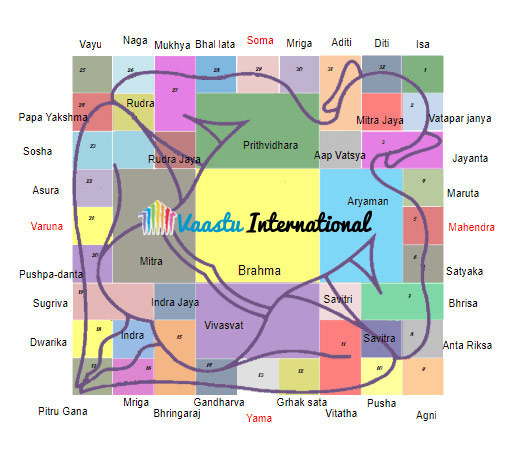
Vaastu Shastra evolved as an answer to the need for healthy living, and was used extensively in temple design and structure. While it can be argued that Vaastu Shastra is conceptually similar to Feng Shui since both serve to harmonize the flow of energy through the house, it differs in the details, such as the exact directions in which various objects, rooms, materials etc are to be placed.
Vaastu refers to the actual physical manifestation of the dwelling, and is represented by the following:
The earth/ site - Bhoomi, the principal dwelling place on which everything else rests
The structures built on the earth - Prasada
Movable objects (vehicles) - Yaana
Furniture - Sayana
The principles of Vaastu Shastra thus, extend across the complete spectrum - site selection, site planning and orientation, zoning and disposition of rooms, proportional relationships between the various parts of buildings and the character of buildings.
Philosophy of Vaastu
Vaastu is based on the concept of space (subtle energy) as a dynamic element from which all objects of nature come into existence and into which all ultimately disappear. The frequency of vibration of this subtle energy, based on a particular rhythm or time measure, causes the birth and development of all objects of nature.
The main aim of vaastu is to create building spaces in harmony with nature. An architect trained in the science and technology of vastu and vaastu designs the building so that its vibrations are numerically equal to the vibrations of the occupants of the building which is determined by their birth stars.
Vaastu Purusha Mandala
Purusha refers to energy, power, soul or cosmic man, while Mandala is the generic name for any plan, which serves as a symbolic representation of the cosmos.
A specific type of mandala used in Vaastu Shastra, the Vaastu Purusha Mandala is central to Vaastu Shastra, and serves as the mathematical and diagrammatic basis for generating an architectural design which incorporates the influence of physical, environmental and spiritual factors. The symmetrical geometric shapes of the mandalas draw the attention of the viewer towards their center.
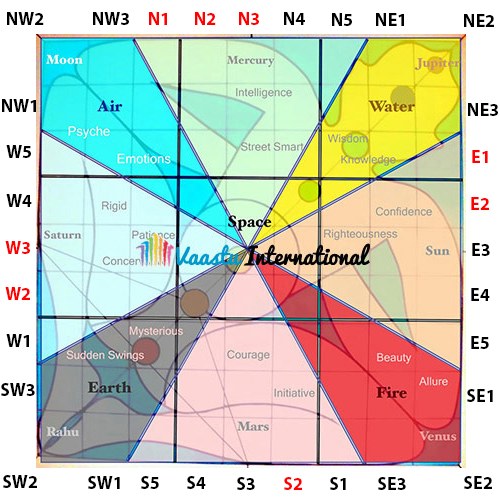
In Hindu cosmology the surface of the earth is represented as a square, the most fundamental of all Hindu forms, where the four corners refer to the four directions, North, South, East and West. It is called Chaturbhuji, four cornered, and is represented in the symbolic form of the Prithvi Mandala. Vaastu Purusha identifies the importance of an area by placing his head to the north-east (balanced thinking) and his lower body to the south-west (stability and strength). His navel is in the center of the area (cosmic awareness) and his hands to the north-west and south-east (movement and energy). Thus, while modern architects tend to pay greater emphasis on the aspects such as aesthetics, ventilation, sunlight orientation and location, the Vaastu Purusha looks into the metaphysical (spiritual) aspects of a structure too. The mandala provides a useful design module for locating the various rooms of a habitation, the measurements of which are based on a set of six formulae normally referred to as the Ayadi Shadvarga. According to the legend of the Vaastu Purusha, a formless being once blocked the heaven from the earth. Brahma, along with the other Gods was forced to trap him to the ground. This incident is depicted graphically in the Vaastu Purusha Mandala with portions allocated hierarchically to each God based on the contributions and positions in performing this act. Brahma occupies the central portion, the Brahmasthana, with the other Gods distributed around in a concentric pattern.
The Vaastu Purusha is the presiding deity of any site. Usually he is depicted as lying on it with the head in the Northeast and the legs in the Southwest but he keeps changing his position throughout the year.
Directions and their respective rulers
North-east (Ishaan) - ruled by Sadasiva or God Himself. Hence this direction is the most important, and deserves to be kept scrupulously clean, open and highly receptive.
East - ruled by Indra, the chief of the gods, giver of pleasures. The direction also represents the realm of the rising Sun projecting ultra-violet rays, and is hence essential for health.
South-east - ruled by Agni, is the habitat of fire, the storehouse of energy.
South - the abode of Yama, the god of death.
South-west - (Nairutya) is the abode of Putna demoness.
West - ruled by Varuna, the god of ocean.
North-west - (Vayavya) is the abode of air/wind, the invisible, but the most effective direction for all objects in need of motion/movement for their efficiency.
North - the abode of Kuber, the god of wealth.
Directions and Deities
The principal deities of each direction (called the ashtadikpala) are:
* Northeast- Ruled by Lord of all quarters or Eeshwara Shiva
* East- Ruled by Sun God - Aditya
* Southeast- Ruled by Lord of Fire - Agni
* South- Ruled by Lord of Death - Yama
* Southwest- Ruled by ancestors
* West- Ruled by Lord of water
* Northwest- Ruled by Lord Of Winds
* North- Ruled by Lord of Wealth
* Centre- Ruled by Lord/Creator of the Universe
After selecting a proper and auspicious plot, and having performed the rites of laying the foundation (Shilanyas ceremony) on an auspicious day, work should be started to construct the building according to preplanned measurements and design shown in map drawn on suitable scale. Directions, level etc. should always be kept in mind. A little carelessness may cause some default in the construction which would put the whole family in troubles and the life would be unhappy.
First of all it is necessary to consider the construction of walls. Stone wall should be raised along the outer edge of the floor. Brick wall should be raised keeping half of it out and half inside edge. Mud-wall built on the inner side is good.
According to Rudrayamal: -
Pashane Sarvato baha mishtikayam tadadhakam;
Mrittikayam pindmatra mityuktam Rudrayamale.
If upper part of a wall is heavier than the lower part, which is not uniformly made, which is thicker at some places, thinner at other places, such a wall causes financial loss. The wall should have thickness equal to one-sixteenth part of the width of the room, wall of thickness more or less than this is not good for the house owner. It was given for mud-walls only. Brick walls can be made of any thickness as may be required. Bricks used should be all new or all old, old bricks should not be mixed with new ones in the same wall. If some old stock must be consumed, then the new bricks should be used over them. Raw and baked bricks should also be used in the same manner.
Effect of the constructed house is also, according to it's shape, good or bad. Mostly the houses are built in the following shapes, their effects are mentioned against each.
Aayatam Chaturastram ch vritam bhadrasanam tatha,
Chakram vishambahum ch trikonam shakatakratih.
Dandam panavaksthanam murajashcha vrihanmukham,
Vyanjanam koorm prashtham ch dhanuha supam ch shodashah.
Shape of House |
Effect |
1. Rectangular |
Allround prosperity |
2. Square (Four equal sides) |
Gain of wealth |
3. Bhadrasan |
Success in life |
4. Circular |
Growth of Knowledge and Health. |
5. Wheel shaped. |
Brings Poverty. |
6. Four (unequal) sides |
Troublesome. |
7. Triangular |
Harassment from rulers (Govt. |
8. Cart shaped. |
Causes diseases, danger of fire, punishment, loss of wealth. |
9. Beam shaped |
Harmful for cattle. |
10. Panavakar |
Harmful for eyes and for house. |
11. Drum (Mridang) shape |
Harmful for women, loss of females. |
12. Vrihanmukhakar |
Loss of family members/brothers. |
13. Fan shaped |
Loss of money and cattle. |
14. Koorm Prashthakar |
Untimely death, murder, imprisonment. |
15. Winnow shaped. |
Loss of property. |
16. Bow Shaped |
Many difficulties; theft and fear of enemies |
17. Hexagonal |
Brings progress and growth. |
18. Elliptical (egg Shaped) |
Loss in many ways. |
19. Singhmukhakar |
Monetary loss, clashes in family and mental tension. |
20. Gaumukhakar |
Peaceful; growth of progeny. |
Shape of the building should be decided keeping in view it's auspicious (good) or evil (bad) effects.
A plot and a house in the singhmukhakar shape is good and beneficial for business, commercial organisations, mills, cinema, etc. and not for residence purpose. Gaumukhakar plot or house is good and auspicious for residence, but brings loss to the business.
Residential house should not be built in front of a temple of gods sun, Vishnu or Shiva; or near a temple of Brahma, or behind a Jain temple, or on any side of Durga temple. Such house is inauspicious for the owner.
Walls
The Boundary wall on the north and east side should be of less thickness, and the walls on south and west side should be built thicker.
Construction of the wall must be started at the South-West corner and work must proceed towards east or towards north in the first phase. At every stage during the progress of work, the height of the wall should be raised gradually in such a way that any wall is lower in height towards the eastern end than that towards the western end; so also the height towards the northern end is always lower than that towards the southern end.
The construction of walls from south east towards north and from North-west towards east should be taken up in the second phase.
Main building must be constructed in the south-west portion of the plot, leaving more space open on the north and east than on the south and west respectively. Main building constructed in the middle of the plot, symmetrically leaving equal open space on all the four sides is also considered to be good.
Basement (Cellars)
Due to the increase in population and lack of land available buildings have to be constructed on small plots, and in such a situation it may be necessary to build a room underground i.e. a basement.
Basement should be built in the north or east portion of the plot. In other portions it will be harmful.
As per principles of Vastu it is necessary to keep the level higher in the south and west than in the north or east. Keeping this in view, a basement (i.e. lower portion) will be auspicious and beneficial only in the north or east portion of the plot as shown in the diagram above.
Basement should not be constructed in the central portion or in the south or west portion of the plot, because a low in these portion is harmful, causing adverse effects according to the Vaastu Shastra.
For proper light and flow of air, ventilators should be provided towards north side in the basement. Stairs or ramp leading into the basement from outside has to be from the north or east. The slope in such cases will be from north to south or from east towards west, which is, possible the passage may be given from south or west side sloping down towards north or east.
Main Entrance Position
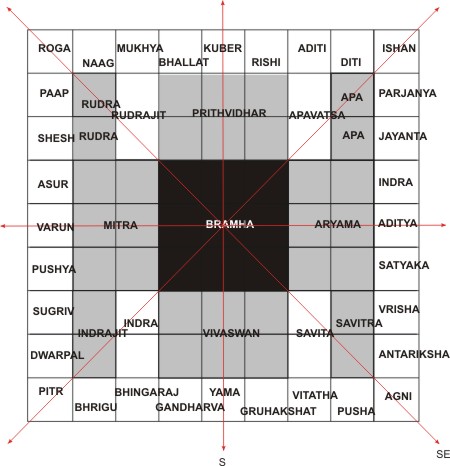
Decision of keeping the main gate in a particular direction is most important before starting the construction. But it depends, to a large extent, on in which direction the plot is open i.e. presence of road, lane, bylane etc. in that direction. Location of the house and it's orientation within the plot are also taken into account. VAASTU Shastra describes extensively regarding the position of the main entrance. The figure given below depicts the appearance of mythical VAASTU Purush and all of it's thirty-two guarding gods. Position of main entrance must be decided accordingly.
There are four methods to decide the position of the main entrance.
According to the guarding deity: Divide the length and breadth of your plot by nine and determine the length of each part. Each part, thus obtained, represents a particular segment on your boundary wall as depicted in the figure and is guarded by a particular deity. If the plot is rectangular in shape, its lengthwise segments will be longer than breadthwise segments. But regardless of it, each segment will have only one deity. The figure also shows as to which part of the given boundary wall is auspicious to errect the main entrance. In the east, segments guarded by Jayant and Indra (3 to 4); in the south, segments guarded by Gruhakshat (12), in the west segments guarded by Pushpdant and Varun (20 to 21) and in the north, segments guarded by, Mukhya, Bhallat and Kuber (27, 28 and 29) are considered auspicious.
Possible outcome of erecting the main entrance on these segments are as follows:
In the East:
(3) Jayant: Wealth, Reputation and Knowledge
(4) Indra: Favour from the state.
In the South:
(12) Gruhakshat: Benefit from the son.
In the West:
(20) Pushpdant: Wealth
(21) Varun: Proper use of the wealth
In the North:
(27) Mukhya: Wealth
(28) Bhallat: Wealth
(29) Soma or Kuber: Spiritual development
Thus, by having the main entrance on any of these segments, occupants of the house will face either north or the east while exiting and hence could avail themselves of the benefits related to these directions. Oval shaped or circular plots can also be divided into thirty-two segments similarly and position of main entrance for the house being built on such plots can be decided upon accordingly.
Determination of the Ninth Part: Great scripture on VAASTU Shastra Vrihat VAASTU Ratnakar writes:
NAVBHAGAM GRIHAMKRITVA PANCHBHAGAM TU DAKSHINE |
TRI BHAGMUTTARE KARYAM SHESHAM DVARAM PRAKEERTITAM ||
That is, divide the length and breadth of your plot into nine parts, and select the position of the main entrance by the following method. Stand on the segment where you wish to make the main entrance and leave five parts to your left-hand side and three to your right hand side. Apply this method regardless of direction.
DECISION BASED ON AUSPICIOUSNESS OF THE SEGMENT
As per the favorable directions, locations within a plot have been classified as excellent, mediocre and wretched. To determine these locations, draw a straight line that connects the central points on the northern and southern wall of your plot. Portions falling on to the right side of this line are termed as auspicious, while those on to it's left side inauspicious. Similarly, draw a straight line that connects the mid point of the eastern and western walls. Portions on the northern side of this line are auspicious, while those on the southern side are inauspicious.
POSITION OF MAIN GATE IN RELATION TO OTHER DOORS
King Bhoj, The famous ruler of ancient Ujjain was a master of VAASTU Shastra also. He has himself authored an exhaustive treatise titled Samarangana Sutradhara on VAASTU Shastra. In the book, king Bhoj describes many positions of the main gate in relation to other doors of the house. A few of them and the omens related to them are discussed here.
UTSANGA: When the main gate and the main door lie in one line facing each other, the situation is known as Utsang. This position of the main gate is considered as excellent.
SAVYA: When the outer main gate is slightly rightward of the inner entrance, the position is known as Savya. It is also very auspicious position.
APASAVYA: When the outer main gate is situated slightly leftward of the inner entrance, the position is known as Apasavya. This is an inauspicious position.
When the outer main gate is situated towards the northern side of the inner entrance which faces either east or west, the situation is known as Prishth bhanga and is regarded as inauspicious.
Apart from the above mentioned positions, there are eight sub corners wherein, having the main gate has varying consequences.
A plot of land can have more than one main gate depending upon the number of roads and lanes surrounding it. In such situations also the main gates must face the auspicious direction and be situated in the auspicious corner. The basic concept behind selection of main gates position is that the occupants may face the north or the east mostly while making exit. That is why position of the main gate in north, north-east, east, north-east, south, south-east and the west, north-west directions is considered as auspicious.
DECORATON OF THE MAIN GATE
MOOLDWARAM NANYAIDWARAIRABHI
SANDADHEET ROOPARDDHYA |
GHAT PHAL PATRA PRAMATHADIBHISHCH
TANMAGALAOSHCHINVYAT ||
That is, the decoration of the main gate must be more than that of the other doors. The main gate must be decorated with the figures of urn, fruits and foliage, leaves, flowers, creepers, lion, swan etc. VAASTU Rajvallabha dictates that the main gate must be built splendidly and decorated vividly. It should have more decorations than rest of the doors. It must be decorated with auspicious and religious insignia. OM, Swastika, urn mounted with coconut, goddess Lakshmi showering gold coins, cow, feeding a calf, figure of Kuldevata (tutelary deity) etc. is few such figures that can decorate the main gate. Idols of armed guards can be bas relieved on each of the two pillars comprising main gate.
DIMENSIONS OF THE MAIN GATE
STHANMUPDWARAMASHTAU DEVA IME KATHITAH |
TRIKARAM PANCHAKARAM SAPTKARAM DWARVISTARAM ||
That is the width of the main gate must be a multiple of 3, 5 or 7 and it's height must be double than its width. Thus, if the width of the main gate is 3,5 or 7 feet, its height will be 6, 10 or 14. But in today's context dimension of 3x6 seems ideal.
If the main gate is installed in the shape of a door, it's frame should have a thickness of six inches on the sides while it's threshold and sill should be nine inches in thickness.
Raised threshold is required to prevent the entry of the crawling insects and serpents. If the main gate in situated on a platform, raised threshold is not necessary.
The main gate should open inward and not outward. It should not touch the walls when opened. These thing preserve the accumulated energy in the house.
PASSAGE THROUGH MAIN GATE
Passage leading to the main gate and the one passing through it must be exactly the same. The passage leading to the main gate should be double in width than the one passing through it. It must have an outward slope as well. Such a passage adds to the beauty of the house and facilitates the entrance of Lakshmi, the goddess of wealth. If the main gate is somewhat higher, easy flight of steps should lead to it.
ENTRANCE, DOORS AND WINDOWS
Main entrance of a house must comply to its main gate in every aspect. It should have better built and decoration than rest of the doors but not more than the main gate.
For a house that has a greater number of doors and windows, it doesn't matter if their total number is odd or even. There is no restriction on the number of the doors and windows and the directions they face. If a house has only one or two rooms, it should then have even number of doors and windows. Most of the windows and almirahs, however should be provided in the northern and eastern walls whereas western and southern walls should have minimum number of windows and almirahs.
All the doors, windows and almirahs should have their top in the same level i.e. they should be of same height. A door must face a door. If there is no provision of that, a window must be provided to face a door.
Doors of different storeys are usually situated one above the others. In such situation, width of the door in upper storey be at least three inches less than that of the lower storey. Top of all the doors, windows and the almirahs however should be at the same level in every storey.
Each room must have two doors. If for some reason, only one door could be given in a room, absence of the second door should be compensated for by a window. This allows ample of sun and air in the room, which is beneficial for the health of the inmates.
All the exit doors should open inward. This is also necessary from the safety point of a view.
COLOUR COMBINATION
Colours represent different wave lengths of a spectrum and are thus nothing but forms of energy. Their effects on the mind and the body are well proven now. You yourself might have experienced that sitting in a room with walls of a particular colour you feel melancholy, while in another room with different colour you feel happy. The implications are clear that you should choose only those colours that have pleasing effect to paint the walls of your room.
Light green, sky blue, azure, pink, light blue and white are such colours with pleasant effects. Red has medicore effects. Bright red makes the occupant short-tempered and leads to loss of wealth. Black and chocolate colours too have inauspicious effects.
OPEN SPACES ADD BEAUTY TO YOUR HOUSE
Atharveda clearly dictates regarding the beautification of a house so that the occupants could pass their lives happily in it.
Accordingly, an ideal house must have ample open space around it allowing unabated ventilation from all the four sides. It should be provided with sufficient number of doors and windows as well.
Atharveda also dictates to have a door facing a door in a room so that the cyclical magnetic flow could be completed. Air flow is also unabated in such a room.
Savants of VAASTU Shastra have deeply analysed the necessity of open space in and around a house. They have concluded that a house should have maximum open space in the northern and eastern sides. Western side can have some open space while the southern side should have least or none. Open space in northern side yields wealth, while in eastern side gives brilliance, knowledge and fame.
Vastu Advice For The Construction
We will provide you with the following details:
- About the proportions of open spaces and built space.
- Shape and height of the building levels.
- Slopes of floor and roof.
- Boundary walls height, design, and thickness.
- Stairs-location shapes and rise.
- Placement of the main gate doors windows, ventilators, and cupboards.
- Electricity meter, main line, lighting system.
- Placement of all the rooms, kitchen, bathrooms.
- Placement of the water sources like overhead tanks, underground tank, septic tank.
- Use of Eco- friendly materials.
FOR VASTU SHASTRA IN HINDI CLICK HERE
FOR 45 DEVTAS OF VASTU PURUSHA MANDALA IN HINDI CLICK HERE
FOR 16 VASTU ZONES IN HINDI CLICK HERE
FOR FIVE ELEMENTS OF VASTU IN HINDI CLICK HERE
FOR AYADI VASTU IN HINDI CLICK HERE
FOR GEOPATHIC STRESS VASTU IN HINDI CLICK HERE
FOR VASTU AND COSMIC ENERGY IN HINDI CLICK HERE
FOR VASTU TIPS IN HINDI - CLICK HERE
VASTU TIPS FOR PAINTINGS - CLICK HERE
VASTU TIPS FOR CLOCK IN HINDI - CLICK HERE
VASTU TIPS FOR REMOVING NEGATIVE ENERGY IN HINDI - CLICK HERE
VASTU TIPS FOR POSITIVE ENERGY IN HINDI - CLICK HERE
VASTU TIPS FOR CAREER IN HINDI - CLICK HERE
VASTU TIPS FOR MONEY IN HINDI - CLICK HERE
VASTU TIPS FOR HAPPY MARRIED LIFE IN HINDI - CLICK HERE
VASTU TIPS FOR PLOTS IN HINDI - CLICK HERE
VASTU TIPS FOR BEDROOM IN HINDI - CLICK HERE
VASTU TIPS FOR KITCHEN IN HINDI - CLICK HERE
FOR VAASTU MEDITATION - CLICK HERE
FOR AROMA VASTU TIPS - CLICK HERE
FOR CRYSTAL VASTU (RATNADHYAYA) - CLICK HERE

Er. Rameshwar Prasad invites you to the Wonderful World of Vastu Shastra
Engineer Rameshwar Prasad(B.Tech., M.Tech., P.G.D.C.A., P.G.D.M.) Vaastu International
|