VASTU ARCHITECTURE
Building Biology

Bau-biologie, a term coined in Germany, is a word used to describe a movement promoting the use of healthy building principles as a means to improve living and work spaces and the health of people who occupy them. Bau-biologie literally means, "building biology." Both terms are now used interchangeably and both have exactly the same definition.

"How Buildings Impact Life and The Living Environment."
This new field of education is characterized by the terms biological, ecological, sensitive to nature, healthy, vital, human, organic, high quality, cultural and holistic.
Bau-biology translated from German is "building biology" or "building for life." It specifically refers to the study of the impact of the built environment on human health and the application of this knowledge to the construction or modification of homes and workplaces. It studies the interwoven relationships between people and their homes as well as their homes and the earth.
Building Biology considers your home or work space to be your third skin: ideally a breathable, flexible and indigenous structure that is organically built to support, shelter and nurture the body, mind and spirit.
For over 40 years Bau-biologists have researched the effects of indoor environments, identified the major causes of indoor pollution and documented the most effective strategies for reducing your exposure and lessening the toxic burden on your health and the earth.
Ancient Taoist Alchemy defines vitality as the basis of health and longevity and the foundation of immunity and resistance. In today's world, many external influences deplete our vitality on a daily basis - one of the biggest being our indoor environments. Loaded with VOCs from carpets, paint and office machines, cleaners, polluted air and man-made electromagnetic fields (EMFs), our homes and workspaces have become dangerous to our health, vitality and longevity.
We now spend over 75-90% of our time indoors in unhealthy environments, sealed from nature and surrounded by artificial light. It is beneficial to learn how to redesign your home into an organic, vibrant and healthy living space.
Building biology is a blueprint for creating healthy indoor environments.
The History of Building Biology
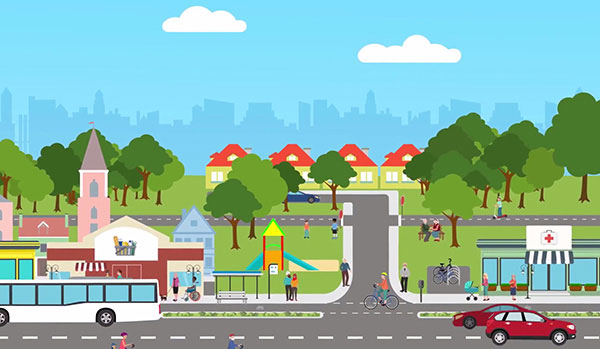
Building Biology began in post-war Germany. Materials that were used to rebuild the country quickly and cheaply had a devastating effect on the individuals occupying these new structures. Much of the population became ill from these buildings, and their illnesses placed a large burden on the health care system. Today we would call this Sick Building Syndrome. The study of Building Biology was born from this impact on society. Anton Schneider, PhD, spearheaded the development of Bau-biologie or Building Biology and over the years began developing guidelines for healthy homes and workplaces. Building Biology is well known to architects and health professionals in Europe. In the United States, the momentum is growing.
In 1986, Helmut Ziehe, a German architect, was given permission to translate the Building Biology materials to English and develop the Institute for Bau-biologie and Ecology in the United States. Since then, the Institute has been providing education that leads to professional certification as a Building Biologist.
The Building Biology Philosophy
Building Biology- is not a look back on a seemingly ideal past, but the vision of a future worth living.
- is not primitive improvisation, but outstanding and responsible innovation based on aesthetic principles.
- is not formalism, but takes nature as i'ts role model. (Nature also features an abundance of shapes and colors.)
- does not limit itself to advantages of individual occupants, but also shows consideration for fellow humans and the environment as a whole.
- is not just about reducing the toxicity of individual building materials, but calls for a total approach to a healthy living environment.
- is not an additional luxury item for only a few, but will form the foundation of future building activities worldwide.
- is not too expensive, but includes the real costs up front, which in conventional building methods are passed on to the general public, the next generation and the environment.
Use of Building Biology
Building Biology refers to how our buildings impact our lives. It is about improving these spaces therefore improving the health of the people who occupy them.
Building Biology looks at the health hazards that affect our every day life. These include such things as:
Chemicals - Products such as our cleaning products, bleach, dishwashing liquids, fly sprays, hair and skincare products contain harmful and dangerous chemicals and we look at how we can replace these for a non toxic alternative
Electromagnetic fields - These include such things as the location of the electrical box, electrical appliances, power lines, televisions, computers and electric blankets. These can contribute to electromagnetic radiation and constant exposure to these can contribute to a decline in our health.
Air Contaminants - Mould, dust, organisms and metal particles contaminant our air and can make us sick. Good housekeeping and plenty of ventilation can help to lead to a healthier home
Water Contaminants - Our water can be contaminated by various means with the main source being the massive amount of combustion products from industry and the motor vehicle. Tap water should be filtered by a quality water filter prior to drinking.
Moisture Intrusion - This can be from an external source, from the environment or from your bathroom and laundry activities. If the moisture is allowed to damage building materials it can help support the rapid growth of moulds, mildews and bacteria which can lead to illness. The source of the moisture must be found and fixed.
Building Materials - In today's society building materials used encourage us to lock up our homes so we can cool and heat them, make them smell nice and provide us with an artificial atmosphere. Open the windows, let the fresh air flow through, good ventilation is very important.
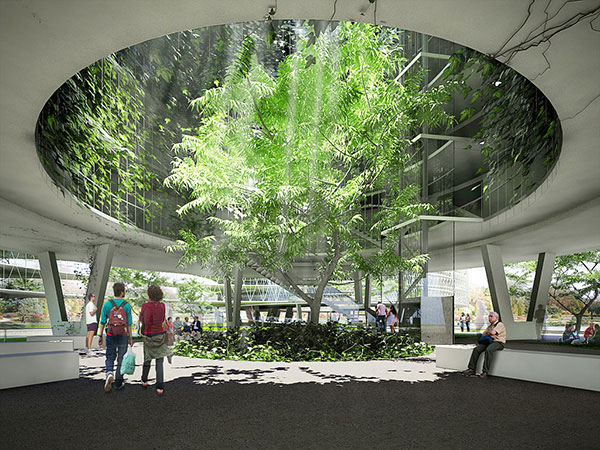
The goal of all recommendations from Building Biologists is to safeguard the health of all building occupants including the construction workers.
Foundations Of Building Biology (Bau-Biologie)
- Geo-Biology needs to be considered in the selection of building sites. Physics and Chemistry fundamentals point out that reduction of the Geomagnetic background will have an impact on the necessary chemical processes needed for life. Certain locations exhibit relatively permanent magnetic distortions, that cause this mechanism to play out.
- Dwellings should be located away from centers of industry and main traffic routes. People need a certain amount of stress to motivate and challenge. An excessive amount, however, tends to build stress level and become intolerable, manifesting side effects as health consequences.
- Dwellings should be separated with spacious amounts of green areas. Cluttering and congestion, like stress, deserve a limited time slot in our daily life. One should find time and space to relax and feel unconfined.
- Dwellings should be planned individually, considering the human aspect and the needs of the family. All too often many homes are built on a speculative nature. People in a "hurry" buy them, and are then forced to retrofit, and / or redesign portions to suit their needs. Obviously, many individuals buy a home not considering the possibility of building one, and then wish they had.
- Use building materials of natural (local) origin. Aside from the environmental impact, cost reduction effects immediately come into play when materials of local or nearby origin are used. Additionally, when considering mold dispersion, materials that are foreign to the building site may present a "meal" to an otherwise innocuous mold population.
- Use wall, floor, and ceiling materials that allow for air diffusion. A natural and passive air exchange mechanism comes into play, reducing the need for active mechanical systems.
- Allow for natural regulation of indoor humidity by the use of Hygroscopic building materials. Most "modern" homes are constructed with airtight wraps of one form or another, instead of porous and permeable natural materials.
- Interior surface materials should allow air infiltration and neutralization of pollutants. Most "modern" furniture includes sealed wood surfaces, plastic furnishings, fungicides, and various other chemicals that add to the indoor toxic load, rather than remove from it.
- Consider the balance between indoor heat storage and thermal insulation. Interior structures should serve as thermal masses, instead of total isolation from the environment necessitating fully artificial climate conditioning.
- Consider the balance between surface temperature and air temperature. Some inefficient heating / cooling mechanisms use forced air as the thermal agent, causing rapid rise and fall of perceived temperature, further necessitating additional means to "condition" the air motion (moisture, filtration, etc.) for sensible comfort.
- Use thermal radiation in heating, employing Solar Energy as much as possible. Consider South-facing major window placement (in the Northern Hemisphere).
- Promote low humidity and rapid desiccation in new buildings. Most "modern" methods of habitation include occupation immediately upon structure completion. This precludes any chance of "baking" the structure to reduce grievous out-gassing effects later on. Baking simply entails raising the structure temperature and rapidly exchanging air with outdoors. Several cycles are generally sufficient.
- Buildings should be neutral in odor, or smell pleasant. Reduction of artificial aromatics and use of natural plantings will greatly aid in producing this comfort.
- Use light illumination and color in accordance with nature. Subtle psychological mood altering effects can easily be produced by certain combinations of light intensity, quality (spectral distribution / flicker content), and color.
- Provide adequate protection from noise and sound conducted through solids. Proper resting requires reduction from normal daytime noise levels. The necessity and value of Proper resting cannot be overestimated.
- Use building materials which emit little or no radiation. Ceramic Tile and Marble, Brick or Block, as well as Gypsum Board may contain source materials that belong in shielded enclosures, not in homes. Additionally, geological fissures and other irregularities may provide for Radon ingress that can cause serious problems.
- Preserve Natural Electric Field conditions (space charge) and physiologically advantageous ionization. An air ionizer is equivalent to a raging rhino trying to lull a baby to sleep. Similarly, the "modern" residence contains electrical environmental conditions that warrant sophisticated mitigation techniques, for a properly "friendly" background.
- Refrain from altering the Natural Magnetic Field background.
- Minimize technical Electromagnetic Fields (EMFs).
- Restrict alterations of important cosmic and terrestrial radiation. This is a two-edged sword, in that to allow this to occur, we also permit the entry of multi-faceted electromagnetic emissions that have become abundant only during the last hundred years, and some only as old as five or ten years (with new emission schemes emerging regularly), with questionable benefit to the individual or society, much less to those who are trying to find peace from this EM deluge.
- Employ physiologically designed furniture and spaces using Ergonomics. People are not produced in a mold where one size fits all. However, due to economic and fabrication processes, it is easier to find a standardized appurtenance of whatever form, where the individual is forced to adapt to the standardized form, than vice versa.
- Design shapes and proportions in Harmonic order.
- Neither the construction nor the production of building materials should contribute to environmental problems and high energy costs.
- Building and production methods should not contribute to the over-exploitation of limited raw materials.
- Building and production methods should not promote social damage through harmful side effects. This is where morals come into play. Due to "modern" relativistic "standards", each individual is entitled to his / her opinion as to what is right. However, upon close observation it becomes intuitively obvious that the proper course to take would benefit all, and is underscored by fundamental truths that transcend time and societal boundaries.
Indoor Climate
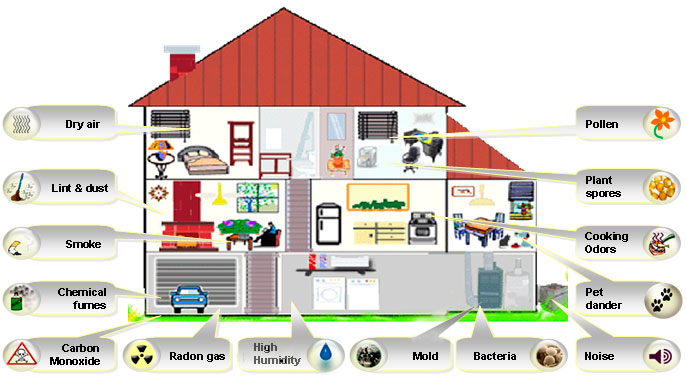
It is no secret anymore that buildings especially modern housing can and do make people sick. This phenomenon has been studied for at least 20 years. The list of potential indoor pollutants and effects of low-level electromagnetic radiation is growing longer each year. The symptoms caused by sick homes are classified as Sick Building Syndrome (SBS), Building Related Illness (BRI) and Environmental Illness (EI).What is causing an indoor air problem?
First of all it is the quality of the outside air. If you live in a big city or near an industrial area, your starting point is much worse compared to living in a rural setting, or even better near a beach or a waterfall.
Secondly, from testing we know the inside air is worse than the air outside because airtight buildings that often have insufficient ventilation are combined with building materials that outgas toxic chemicals. Mold growth as a result of moisture damage is also a factor in indoor air quality. All this causes a multitude of body problems such as headaches, asthma, allergies, hormone disorders and even cancer. The symptoms can be much more pronounced in small children, sick people and the elderly.
What is the answer?
- Use natural building materials as much as possible.
- Avoid products that have strong fragrances (cleaning and personal care products).
- Be careful with carpets and plastic building materials, paints and glues.
- Provide plenty of natural ventilation by having windows that can be opened just to name a few.
Our advice is to take preventive action rather than waiting until these toxic substances affect your health. IBE provides information for both professionals and lay people which when applied will help to create safe living and working spaces.
Electromagnetic Pollution
EMR or electromagnetic radiation is not a new concept in our life. Actually it is a very integral part of our lives because without this electromagnetic energy life would not be possible.
What is the problem we seem to have with electromagnetic radiation?
Well, since time began until about hundred years ago life had to deal with naturally occurring radiation, which somehow was balanced or life was shielded from detrimental parts of that radiation such as certain cosmic radiation. When people started to harness electricity and began to generate and transport it over long distances a different kind of energy was introduced to our life: AC electric, AC magnetic fields and radiofrequency radiation.
Over time, industry found newer and more exciting usage of that energy. It started with simple motors, refrigerators, doorbells, electric blankets, etc., via electric heating systems, communication systems such as radio and television, and is now engaged in sophisticated electronic devices, including military weapon systems, satellites, computers and cell phone technology.
These manmade energies have become part of our lives and as such are superimposed to our subtle body energies. The result of this development seems to be an increase in certain illnesses that have been unknown or at least rare before the electricity age. Research into the long-term effects of an exposure to EMRs is in the beginning stage and hampered and stopped by vested interests.

In Building Biology we recognize the potential health problems and provide measures to eliminate or at least minimize the negative impact of electromagnetic radiation.
IBE provides plenty of information for both professionals and lay people which when applied will help to create safe living and working spaces. You can study our printed material, the Online Study Program, or attend one of the Professional Seminars.
Bau-biologie is the study of the impact of the "built" environment on human life. We study the building and its impact on the physical, emotional, spiritual and mental being of the people who are living or working inside.
By understanding the influences the building may have upon people, we may effectively create healthier, more harmonious and more productive environments.
Building Biology Tips
1. Unplug any unnecessary electrical items in your bedroom so you are not sleeping in a sea of electromagnetic fields (EMFs). Most importantly, keep items such as alarm clocks, tape players, radios at a safe distance from your head.
2. Use 100% natural linens for your bed, to avoid allergies. Avoid polyester!
3. Attach a grounded glare guard to an older computer to reduce EMFs and make working much easier on your health. Newer computers have built in lower EMFs.
4. Keep electric calculators, pencil sharpeners and other electronic equipment unplugged until you need to use them. These items emit high EMFs that can negatively impact your health.
5. If you have a sewing machine, keep it unplugged when not in use, as it emits high EMFs.
6. Look for potentially dangerous EMF sources that might be hidden in your bedroom. Avoid placing your bed against a wall that might have one of the following on the other side of the wall: main power source to the building, circuit breaker box, stove, refrigerator, pool pump.
7. When building a new home or building out your new business space, incorporate healthy concepts. Consider using non-toxic glue for carpeting; non-toxic paint for the walls; tile, cork, bamboo or natural carpeting for flooring, and natural fabrics for furniture. These will help prevent out-gassing and will make your environment a healthier and more productive place to be in.
8. Consider using full spectrum lighting in place of fluorescent tubes, particularly in your workspace. This creates the closest lighting to daylight, and relieves much stress in the body.
9. Test your drinking water regularly, even if you have a filter. Consider installing a reverse osmosis or distilled water unit for removal of most TDS (total dissolved solids).
Tips for Healthy Cleaning
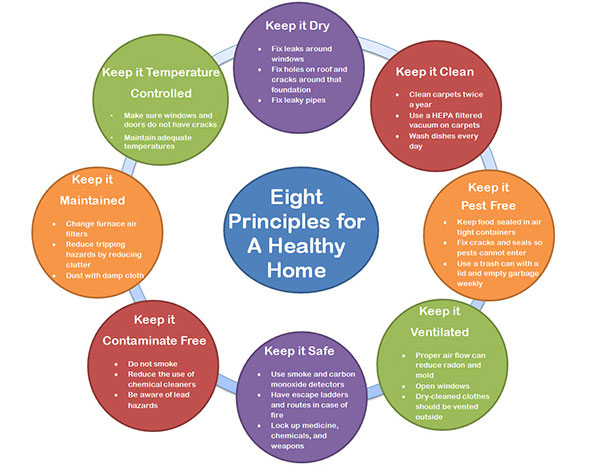
1. Purchase a HEPA (High Efficiency Particulate Air) filter vacuum cleaner. It is most effective in trapping the smallest dust particles, which allows you to breathe easier.
2. Use a non-toxic floor cleaner, such as Earth Friendly Products combined with water. This will stop the introduction of chemicals found in typical cleaners into your environment, which can be harmful to your health.
3. Wash your windows, mirrors and glass with a ½ each solution of vinegar and water. Use newspaper or cotton cloths to wipe the surfaces.
4. Use a non-chlorine bleach substitute instead of bleach.
5. Vinegar or lemon juice with a few drops of olive oil is an excellent wooden furniture cleaner. Apply it with a cotton cloth. Alternatively, use a commercial, natural non-aerosol product.
6. Use an ammonia-free and fragrance-free cleanser in a spray bottle for your bathtub, shower, and tiles.
7. Use an ammonia-free and fragrance-free detergent, such as Sun & Earth’s Hypoallergenic Dishwasher Liquid with aloe for cleaning dishes.
8. Consider replacing your washing machine with a front load, low-water unit. Use a non-fragrance cleaning product. If you are wearing 100% natural clothing (cotton, linen, silk) you will not need a fabric softener.
9. For air freshening, try opening the window! If that isn’t possible, consider adding plants to the room to absorb odors and chemicals. Another alternative is a potpourri of dried, fragrant, organic herbs such as lavender in an open container.
Building Ecology
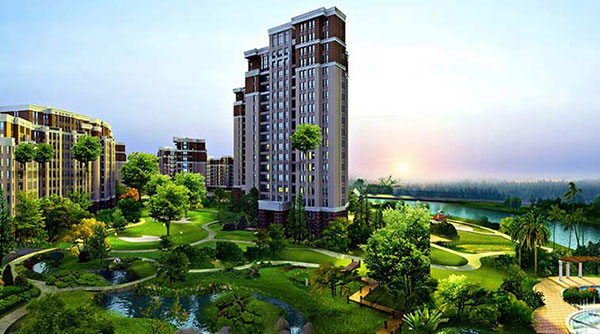
Building ecology encourages us to build in consideration of nature. It is the interaction of the building, with the environment it is built in. To create an environment in harmony with nature, we must consider the location, materials used, the use of the structure, and, the relationship of the people to the space.
Some Guidelines of Building Biology
These guidelines are based on several fundamental principles of building biology.
- Use natural and unadulterated building materials.
- Using wall, ceiling and floor materials that allow air diffusion and are "hygroscopic," meaning that they naturally regulate indoor humidity.
- Filter and neutralize air pollutants.
- Use radiant heat (as opposed to forced air) and as much passive solar heat (windows that allow sunlight to shine into home during cold winter months) as possible for the heating system.
- The total moisture content of a new building shall be low and dry out quickly.
- A building shall have a neutral smell.
- Eliminate or reduce man-made electromagnetic radiation (EMR) as much as possible.
- The production, installation, and disposal of building materials shall not contribute to environmental pollution and high energy costs.

Tips for Creating a Healthy Environment
-
Avoid living or working in buildings near electrical high tension wires.
-
Avoid placing your bed near the electric panel in your home or office.
-
Avoid electric waterbeds.
-
Avoid the use of electric blankets.
-
Avoid the use of alarm clocks, stereos, TV’s in your bedroom, particularly near your bed.
-
Select wood bed frames with all cotton futon or natural latex mattresses.
-
Avoid the use of microwave ovens, which emit microwave fields, in addition to changing the molecular structure of your food.
-
Use natural, breathable fabrics and materials in your clothing, furniture, and environment.
Building biology may still be a relatively obscure science, but by following these rules, you can help make your home safer no matter where you live.

Er. Rameshwar Prasad invites you to the Wonderful World of Vastu Architecture
Engineer Rameshwar Prasad(B.Tech., M.Tech., P.G.D.C.A., P.G.D.M.) Vaastu International
|