DOWSING
Tools of Dowsing
What Tools are required?
The first point to get clear is, that there is no magic built into the tools. They are inanimate indicators which are moved subconsciously by the dowser in accordance with that dowser’s ‘Code Language’, which can be different for every one.
Essentially, simplicity is the keyword, some dowsers use all sorts of tools while some, myself included use the simple things in life which, at the end of the day, give you the same results ...
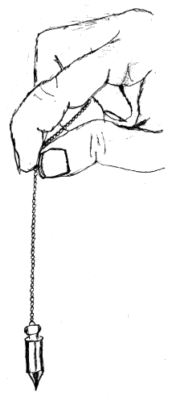
The pendulum : This is a simple weight on the end of a piece of cord or light chain. The wooden light pulls are ideal but the pendulum varies from a key on the end of a bit of cord to a ring or a crystal. I use a piece of hazel twig for indoor working and a heavier crystal for out doors, simply because you need something that will be heavy enough not to be blown around by the wind. The pendulum is the most versatile tool for use in ‘map dowsing’ and straight question and answer type of dowsing. For me, it rotates in a clockwise direction for ‘YES’ and anti-clockwise for ‘NO’. It swings from side to side if the question is not understood and backwards and forwards in the ‘Search’ position.
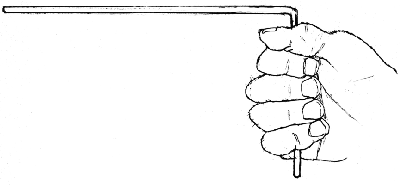
Angle rods : The easiest and simplest of all tools to use. They are just lengths of wire bent at right angles and can be made quite easily from old metal coat-hangers, welding rods, thin brass rod, thick wire., for example; take a pair of wire coat hangers and cut them so that the top is about 9 to 12 inches long and from the angle towards the hook for hanging, about 4 to 5 inches long, then, having cut it, bend the angle to 90 degrees. The short length is held in the hand as the handle. However again in windy weather, I have a pair of rods of 6 mm brass rod (almost 1/4 of an inch in diameter).
‘V’ rods : Again there are various sizes, weights and materials. The traditional being hazel, this was mainly because it is a pliant wood that doesn’t dry out too quickly. Quite commonly today, plastic is used at a length of about 16 to 18 inches long.
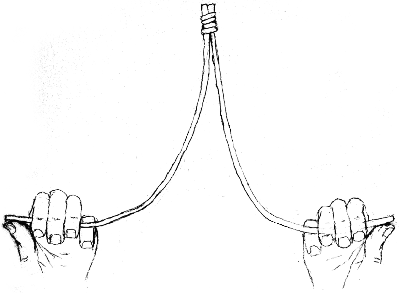
Double ‘VV’ rod : This is made as above except that it is in the shape of a ‘W’. The advantage of this is that it is very accurate when locating and tracing small pipes etc. However, it is difficult to get used to.
Wands : These are just springy lengths of thin branch about 36 inches long and are ideal for dowsing up a wall, for example following the path of an old chimney – these tend to meander up the walls of old houses. A modern materials are taking over and the usual wand is a 36 inch length of fairly thin plastic.
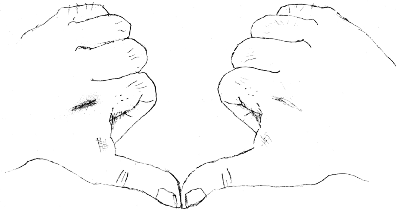
The body itself and the hands :
Instructions for Pendulums Dowsing :
Any evenly weighted object will work as a pendulum in fact a wedding band makes an excellent pendulum. Simply tie a thread to the band so that it acts as a swing, a pendulum.
To hold your pendulum properly arch the wrist so that the thread is clasped between the forefinger and the thumb so that it can have a direct drop.
Find a quiet place where you will not be disturbed by phones, kids, or road noises. Take a few deep cleansing breaths and visualize yourself connected to the earth through your feet which are placed firmly on the ground beneath you, this is called grounding and centering yourself. Tune into your "higher-self," your own unique divinity.
You can start a slight oscillation artificially if you want as a beginner to overcome inertia, then let the natural force take over the pendulum's motion. The body acts as a magnet, it has a positive and negative side. Avoid neutralization, do not cross your hands or feet from one side to another while dowsing.
Ask to see your "yes" signal - for most people this is a front to back swing similar to the yes nod of your head. Then ask to see your "no" signal which is generally from right to left as if nodding your head no. Ask to see your "maybe" signal, this will be different from the other two signals, perhaps a circular motion.
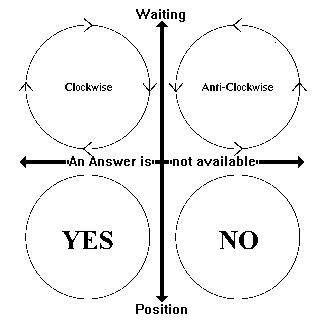
Techniques often do vary from person to person, there is no absolute 'right' way. You customize it to your liking. Not everyone's code is the same, ascertain yours then stick to it; always check your code before each session to make sure it hasn't changed, as it sometimes does!
To determine if conditions are right for dowsing use your pendulum to ask your "higher-self" the following questions : "shall I dowse?" "may I dowse?" "can I dowse?" If you receive a no to any of these questions it is best to stop and try again later. Your frame of mind and emotional state is important to your ability to dowse effectively. It is not recommended that you dowse when you are feeling ill or upset; if you must, have someone else dowse for you during these times.
To avoid the possibility of auto suggestion you may want to close your eyes when starting an experiment. Try testing foods. The pendulum should gyrate positively over "good for you" and negatively for the opposite. Be careful to place food in a clean neutral place. Many people dowse for optimum health, good foods, vitamins etc.
Er. Rameshwar Prasad invites you to the Wonderful World of Dowsing.
Engineer Rameshwar Prasad(B.Tech., M.Tech., P.G.D.C.A., P.G.D.M.) Vaastu International
|