DOWSING
Basic Rules of Dowsing
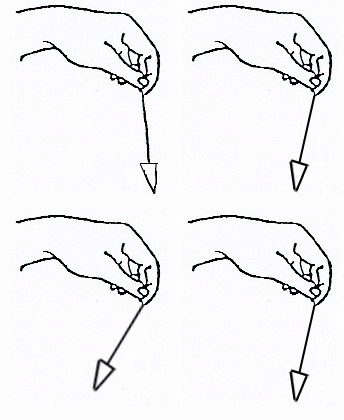
Some Basic Rules :
These are some basic rules which are a guide to beginners but still apply at all stages of the dowser’s career.
1. Virtually all Dowsing is Seeking : Looking for Something. This must be appreciated and the mind focused in this direction at all times.
2. Develop the Dowsing Sensitivity : Before a dowser is any good, it is necessary to develop a dowsing sensitivity. H/she must learn to cut out the brain and the five senses and allow the mind to reach out for the answer. You must practice a lot in your early days and in elementary dowsing work.
3. Practice and Test : To develop 3 above, it is practice and more practice. For instance practice on know things. Dowse someone's well and check your results against those that are known – that is how far down is the water and how deep is it?
4. The Questions Asked Must be Clear : Correct and Appropriate to the Job in Hand. Think carefully and make a list of questions before you start.
5. There Must be a Need to Know : It must be done for a specific task. Dowsing for a client, demonstrating the practice of dowsing – but never to show off with ‘What a good and clever boy or girl I am”.
6. Have Confidence That Dowsing Works for You: This is essential, develop it, hang on to it, you will have failures but so what? - So many people say “Oh yes it works for me, but I don’t think I’ll be any good” The answer to that is “Oh ye of little faith” - get practising.
7. It is Essential to Know the Background of the Field in Which You Are Working: If you want to do archaeological dowsing, get books from the library and learn the basic principles, this applies to anything, Psychic dowsing, any dowsing work.
8. Be Bold in Application : Be prepared to take on anything even those which you haven’t tried before.
9. Time : If there is a question of time, this must be taken into account. E.g., I want the height of the roof above floor level in the year 1250. Everything must relate to 1250 and it must be kept firmly in mind.
10. Identification : If there are many objects similar to that which is being sought there must be some form of identification. Examples are lost children or animals. You are looking for a child, there are millions of children – you should keep in mind – I am looking for a European boy with ginger hair about ten years old etc.
11. Preconceived Ideas – Wishful Thinking: These are the biggest menaces in dowsing and the reason for most failures especially amongst the novice dowsers. Failure come about when you allow the brain and/or the five senses to intrude.
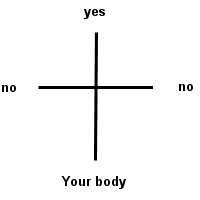
Here's a step by step approach to dowsing for the first time :
1. First ground yourself. The simplest way is to imagine tree roots growing down from the soles of each foot rooting you firmly into the Earth.
2. Next connect to your Higher Self through your crown chakra : visualise a bright white star above your head and draw a strand of it down through your crown.
3. Now centre your energies : take your focus to your heart centre, until you feel this is where you are working from, rather from 'mission control' in the head.
You can dowse without this preparation- but you are likely to be wildly inaccurate!
4. Holding your pendulum in one hand by the chain. let it swing gently in a neutral fashion. Keep your hand & arm relaxed- tensing up will prevent the pendulum swinging freely.
5. Ask a question in your mind for which you know the answer is a 'yes'. I might ask 'Is my name Meeta?' for example. Watch how the pendulum responds. The swing will probably change.
You will most likely feel very excited at this point - it looks so weird! Just remember that you really are moving the pendulum - it isn't being moved by a supernatural force - simply by small unconscious muscle movements in your arm. The pendulum is a way of you accessing the wisdom of your Higher Self through these small muscle movements.
6. Now ask a question for which you know the answer is false 'Am I called Seema?' and again observe the swing. It will probably change.
7. Continue to ask questions for which you know the answers until you have established how the pendulum will swing to indicate a 'yes' response and how it will swing to indicate a 'no'.
8. Once you have established your 'yes' and 'no' swings you can start to ask other questions.
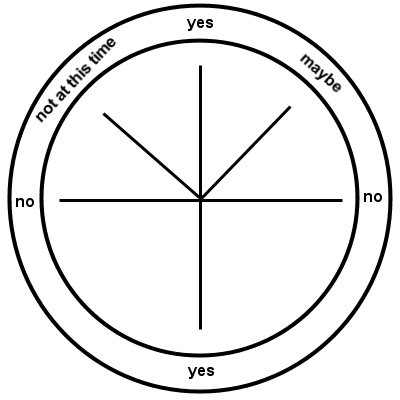
Whilst you are learning dowsing it is best not to ask any 'heavy weight' questions. Dowsing is not infallible, but in skilled hands it can be remarkably accurate. Even so I personally wouldn't make any really big decisions based on dowsing alone & would note my intuitive feelings and look for any other guidance to corroborate the results.
You can use your new skill for all sorts of things. For example you can check whether a foodstuff is healthy for you, if wearing a particular colour would be good for you today, whether a particular crystal, flower essence or homeopathic remedy would help you- the list is pretty endless.
TEN PRELIMINARY QUESTIONS BEFORE DOWSING
OVERVIEW
Question 1:
What's my purpose for dowsing this?
Before you begin dowsing for the answers, write down precisely what you're dowsing for.
Question 2:
What do I already know about this topic?
After thinking about this for a few moments, jot down a few notes on the topic.
Question 3:
What do I want to know?
What's the big picture here? What is the missing piece of information I should be looking for?
FORMULATION
Question 4:
What's the first question?
May l? Can l? Should l?
Question 5:
What questions are important here?
Decide what information is important enough to write down in question form. What's important will depend on your purpose. (Such as "Will I be happy with the outcome?" "Will the customer be happy with the outcome?")
Question 6:
What are the "right" questions?
Each topic poses a unique set of questions. Formulate them carefully.
SUMMARIZATION
Question 7:
How can I summarize this information?
Once you've answered all the questions, are the answers self consistent? Explore both the questions and answers to see if any new groupings or links are created.
Question 8:
Does information fit in with previous data?
As you look over previous answers, try to see how the new information fits in with what you already know-not just about that topic but about others as well.
Question 9:
How can I use this information?
Take notes on the important information you have gained from dowsing the questions.
Question 10:
What is the next step?
After looking over the dowsing questions and answers, do they supply the information to reach the goal or objective?
Er. Rameshwar Prasad invites you to the Wonderful World of Dowsing.
Engineer Rameshwar Prasad(B.Tech., M.Tech., P.G.D.C.A., P.G.D.M.) Vaastu International
|