DOWSING
FAQ (Frequently Asked Questions)
What is dowsing?
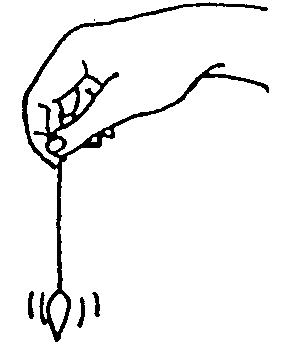
Dowsing can be thought of as a direct line of communication to your own superconscious mind. A pendulum receives information from the deeper wiser parts of the brain, that knows all things. This information in the form of yes/no questions is simply reflected in small muscle movements in the arm and hand to move the pendulum. It is more commonly known as Divination.
What is dowsing used for?
Dowsing is used as a tool for asking questions, giving advice, making decisions and making a selection from a list of options. It can be used to help make a major decision or to make minor decisions. It is also used commercially to locate water, oil, on archaeological sites, soil testing/agriculture, mineral and soil prospecting, and site surveys i.e. hidden mine shafts and underground tunnels. It has also been used by the US military to locate landmines. One may gain unseen information at a distance, (even through material barriers), about a person, creature, object, substance, place or "thing", beyond the limitations of one's five senses and so-called logical, thinking mind.
Can anyone dowse?
Yes. Everyone of us is born with the ability to dowse, however due to lack of knowledge, interest or confidence, people do not utilise this very useful skill. But the quality of Dowsing efforts do vary, depending upon how one approaches the work.
One develops one's own intuitive apparatus through ESP But it is NOT Extra Sensory Perception. It is Extended Sensory Perception. There's nothing extra about it. True Dowsing is an extension of one's natural, feeling, intuitive perceptions.
Must one be gifted to dowse?
No. Dowsing is an intuitional science and can be learned. Divining is not just a gift miraculously bestowed upon a "few".
What equipment do you need?
For pendulum dowsing you will need a crystal or other object that will be able to be threaded with a chain or piece of thread at least three to nine inches long. Pendulums can either be purchased or home made. There are two other types of instruments used for dowsing. Rods and Bobbers. Rods come in two types "L" and "Y" shape. For L shape rods you will need a piece wire 12 to 16 inches long. Y shaped rods are made from plastic, metal or wood and are 12 to 24 inches long. Bobbers are made from flexible wire or branches and are 1 to 3 feet in length. They are sometimes made from coiled wire with a weight on the end. To train your pendulum you will need a piece of plain paper and a pen/pencil.
Do you need to attend a training course?
There are various courses you can attend which will teach you about dowsing, training your pendulum and techniques. However it is practise which makes an accurate and confident dowser. There is a great deal of literature and books available on the subject of dowsing.
What questions can you ask?
You can ask about anything within reason. The most commonly asked questions are about relationships, career, lost/misplaced objects and allergies. To obtain accurate answers the questions must be clear, precise and uambiguous, and require a "yes" or "no" response. Dowsing can be used where a selection needs to be made from a list of options.
What questions can't you ask?
You usually can ask questions about yourself, pets or situations. You can ask about your partner and, or, a close relative, but you must have their knowledge and permission. You should not ask questions about another person without their knowledge or permission or ask another person to dowse questions about medical disorders as this is unethical, Neither should you ask questions for monetary gain i.e. Lottery numbers. Dowsing should only be used for good intent.
Why do you need to train a pendulum?
You need to train your pendulum so that you and it have an agreed way of obtaining your "yes", "no" or an "unsure" response. Most people generally use a circular clockwise movement for yes and an anti-clockwise movement for no. However you can train your pendulum to use backwards and forwards or side to side movements.
How?
Combination of mental, emotional and intuitive faculties are focused, in right order, upon the object of one's quest. Presently, the device moves beyond one's physical control, according to a preestablished code.
One may also Map Dowse (remote locating by chart). With the aid of an instrument and pointer, the Dowser tracks lines, pathways and coordinates with far-off, fixed or moving objects.
How does one begin?
To Dowse, we must have a suitable device and be simultaneously aware on two planes. We live in two worlds; the material outer and imaginative inner worlds of existence. "Higher" (knowing) mind, flourishes within the realms of intuition and responds to noble questions posed by the "thinking" intellect. Quality and quantities of valuable information may be tapped from this great universal source, beyond material considerations.
How Important is the instrument?
Some persons actually receive contact from a distant target, buried object or energy field, without the benefit of an instrument. Others claim they make contact with the help of an invisible guide. We have seen convincing demonstrations of this. The former is more voluntary and, in the latter case, responses are usually involuntary.
Too often, great emphasis is placed upon the instrument, with little consideration given to the operator's skill.
What are the limits to dowsing?
Applications for Dowsing are ever expanding and seemingly limitless :
One may search for underground water, minerals, oil and ore; buried or hidden objects and substances; treasure, lost valuables, missing persons or pets; downed aircraft, lost vessels at sea; earth's telluric currents, energy rings, spirals and ley lines. One may feel wave-fronts from crystals, blessed objects, symbols, signature emanations and the human aura.
Dowsing is used in archeology; also to pin-point mechanical defects in equipment; to rediscover lost survey markers and buried pipes. One may Dowse for purity in foods and soils for planting. The list goes on and on...
Dowsing, an ancient and true science, may be learned and even self-taught through specific methods revealed in our corses and books.
Er. Rameshwar Prasad invites you to the Wonderful World of Dowsing.
Engineer Rameshwar Prasad(B.Tech., M.Tech., P.G.D.C.A., P.G.D.M.) Vaastu International
|