LAL KITAB
Red Book and Astrology
Lal Kitab and Astrology
Lal Kitab and astrology differ on one major basis that is the kundli prepared and the postion of planets in both the kundli. Lal Kitab do not consider the planet is in which house number rather than it consider in which house it is positioned. One peculiarity of Lal Kitab is that the Rasis are not taken into account. The numbers of Rasis which are taken to be identical with house numbers are only important.
The difference between Lal Kitab and Astrology
a) While the conventional Hindu school of astrology is based on many voluminous works by our rishis and munis; the Lal Kitaab is a single treatise written in old Urdu , with no mention of authorship. There are many theories on the reasons behind the author choosing to stay anonymous. The most popular of these theories being that perhaps due to Divine instruction, the author was not interested in taking credit for the work.
Coming back to astrology, the most famous and perhaps the most respected of the works it is based on is the Brihat Parashara Hora Shastra , written by the great sage Maharishi Parashara. In view of this, the conventional Hindu school of astrology is frequently and justifiably referred to as the Parashari system of astrology.
b) The Parashari system is one of pure astrology and refrains from even mentioning other methods of divination (foretelling) such as numerology and palmistry. This could be understood in light of the fact that astrology, palmistry and numerology have progressed in Indian sub-continent as independent, unrelated and hence competitive sciences.
In contrast, the Lal Kitaab is a treatise on astro-palmistry; astrology and palmistry complement and supplement each other instead of competing and deleting each other.
For example, in Lal Kitaab , if the sun is in the second house of a native’s horoscope, he must possess a certain kind of sun-line in his palm. Since the hand is always available, the horoscope can be verified and even cast on the basis of the hand’s print, called a palmoscope, for brevity.
c) In Parashar Hora, the determining inputs for prediction are the the birth chart, the influencing periods or dasas as they are called and the transit movement of planets called the gochar. Indian astrology is unique in having the dasa system, the most popular of them being the Vimsottari dasa system.
The Lal Kitaab refers only to the birth chart, and its own unique number chart to cast the Lal Kitaab varshphal (literally means yearly fruit) or yearly chart of the native. Predictions are made on the basis of the birth and the yearly chart cast. Needless to mention, Lal Kitab does not believe in the dasas and the gochar.
d) While in the Parashari method, the Sun is regarded as the king of all planets and hence the most important factor in the horoscope, in the Lal Kitaab , Jupiter or Deva Guru Bhrispati (the preceptor of all gods, including the Sun ) is given the supreme status.
e) Interpretations of placement of planets in rashis and houses vary greatly in both. For example Jupiter in Cancer in the first house is regarded as excellent by Parashar pundits while the Lal Kitab considers this placement as average.
Instead the best house for Jupiter is second and not the first, and Cancer is not the best sign for it. Similarly Pisces for moon is bad and Scorpio for moon is good in Lal Kitab ; the last part will amaze many because in Parashari school moon is debilitated in Scorpio.

How to create a Horoscope Chart as per Lal Kitab Methodology
The horoscope chart for the Lal-Kitab astrology can be derived from the vedic horoscope charts. The vedic horoscope contains the twelve houses and the location of the planets in to different houses. Each house is also assigned a number that represents the zodiac sign. It represents the position of planet in a particular zodiac sign at the time of native’s birth. The example of the vedic horoscope chart is shown below.
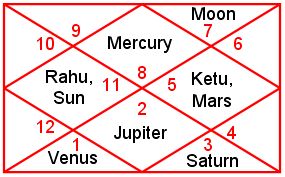
The first house is called the “lagna” and the zodiac sign in the first house will be called its lagna sign. So the total twelve lagans will be possible in vedic astrology. Here in above example the lagna is Scorpio as the number 8 is written inside the first house.
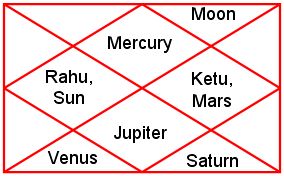
The Lal-Kitab astrology does not give weight to the lagna. It assumes that all the native in the World will have one lagna only and that is “Aries”. So to create a horoscope as per the lal-Kitab astrology, remove all the numbers from the vedic horoscope chart as shown below.
Now re-number each house starting from the first house as shown below.
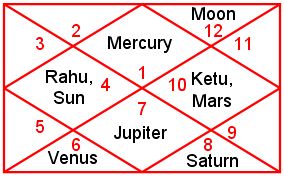
The lagna will be "Aries" for all the natives as per the Lal Kitab astrology. Now the horoscope chart is ready for the analysis as per the Lal-Kitab methodology.
Uses of Lal Kitab
You may follows the given remedies if your kundali is created on the basis of laal kitaab principles.
- The first rule of Lal kitab is to destroy all the malefic planets of the kundali.
- The second remedy of lal kitab is to keep the effects of planets away from the native.
- According to the third remedy, the malefic effects of inauspicious planets are converted into auspicious one rather than destroying it.
- As per the fourth and fifth remedy, a benefic planet may also be established in the place of malefic one.
- In the fifth remedy, an auspicious planet is established to get rid of the conflicts between inauspicious planets.
- In the sixth remedy, an inauspicious planet itself should be converted into an auspicious one.
These remedeis can be found in other system of astrology also other than Lal kitab. But, Lal kitab remedies must be followed according to the rules given in the lal kitab.
Remedies performed according to the principles of Lal kitab can give results equivalent to amrit (holy water). But, they can give opposite results (equivalent to a poison) if you are performing lal kitab remedies for a kundali based on other system of astrology.
Different Kinds of Lal Kitab Horoscope
Lal Kitab Horoscope - Lal Kitab Kundali Types
Andhi Kundali
According to Laal Kitaab, some horoscopes or Kundalis are known as Andhi Kundali. If a birth chart contains more than two enemy planets in the 10th house, the horoscope is known as Andhi Kundali. The collision of two enemy planets in the 10th house makes the house inauspicious. This collision may create instability in employment and might give excessive difficulties to the native.
Aadhi Andhi Kundali
Aadhi Andhi Kundali is formed by the Yogas involving two enemy planets. Its formation is caused by conjunction of two enemy planets. If Sun is in the fourth house and Saturn in the seventh the the horoscope is called Aadhi Andhi Kundali. The native in this condition might have to undergo lots of sufferings in life work really hard to earn his living which leads to unstable and weak financial condition.
Dharmi Kundali
Dharmi Kundali depicts a horoscope in which the negative effect of malefic planets gets reduced to a certain level. If Rahu or Ketu is in the fourth house of a horoscope then it is classified as Dharmi Kundali. It is also formed if Rahu or Ketu are situated in any house of the horoscope along with moon. In both the condition, the effects of natural malefic planets gets reduces and the native attains auspicious results.
Kundali of Kayam Greh
A Kundli of Kayam greh means the presence of planets in a horoscope which are strong in every aspect and are not affected by any other malefic planet. If the enemy planets aspecting the kundali does not have any effect on the sustained planets then it gives auspicious results.
When the planets in your kundli are not affected by any enemy planet or its sign then it known as the kundali of kayam greh. In this kundali, an auspicious planet must not conjunct any enemy planet. It is also known as a planet of fortune or Kismat ka Greh.
Kundali of companion planets or Saathi Greh
When planets exchange places with each other in exalted sign, debilitated sign or in fixed houses, then a Kundali of saathi greh is formed. The inauspicious effects of planets that form companionship in this kundali are reduced and they give positive results.
Kundali of the Mukabale wale Greh
An enemy planet conjucting two friendly planets sitting in the same house creates differences between both the planets resulting in reduced benefic results. In this situation the horoscope formed is known as kundali of mukable wale greh.
Kundali of Nabalig planets
According to Laal Kitaab, a horoscope is considered to be of nabalig planets when the first, fourth, seventh and tenth house of the horoscope is vacant and occupied by malefic planets only such as Rahu, Saturn or Ketu. The results are analyzed by keeping in consideration all the principles of nabalig planet horoscope.
Aspects of planets in Lal Kitab
There are specific principles for planetary aspects in Laal kitaab. With the help of these principles the effects of planets can be understood in detail. In Vedic astrology, the planetary aspects are considered, rather the the aspects of concerned houses. But, Laal kitaab works on its own rules and principles. Here, the aspects of the houses are taken into consideration. For example: the first house completely aspects the seventh house of the kundali.
- The houses that fully aspects each other are ascendant-seventh and fourth-fifth.
- The houses that partially aspect each other are fifth-ninth and third-eleventh.
- The houses that have 1/4th aspect are eighth-sixth and two-twelfth.
- The first house completely aspect the seventh house.
- The fourth house completely aspect the tenth house.
- The third house partially aspects the ninth and eleventh house.
- The fifth house partially aspects the ninth house.
- The second house quarterly aspects the sixth house.
- The sixth house quarterly aspects the twelfth house.
- The eighth house quarterly aspects the twelfth house.
- Two planets fully aspecting comes closer to each other. Two planets aspecting partially divide their powers among each other.
- Two planets quarterly aspecting each other exchange some powers among themselves.
Other rules for aspecting planets
- Inverted eighth house fully spects the second house.
- Mercury in the eighth house also aspects the sixth house.
- Saturn in the sixth house also affects the second house.
Other facts
Mutual help
In the Lal Kitab Kundali of mutual help, each planet will help the planet which is placed in the fifth house from it, whether they have enmity or friendship.
Foundation Kundali (Buniyad kundli)
Planet which is placed in the ninth house from a planet will be known as its Buniyadi planet. In a Laal Kitaab kundali, if Sun is in the ascendant and Saturn in the ninth house then Saturn will be considered as the buniyaad of Sun. Both the planets will completely support each other and share friendly relationship.
Common condition
Planets aspecting according to the rules of Laal Kitaab are considered to be in their normal state. For example: Saturn in the ascendant and Sun in the seventh house are enemy of each other, but this placement is considered to be normal.
Collision
Each planet is the enemy to the planet situated in the eighth house from it and reduces auspicious results, even if both of them are natural friendly planets.
For instance: Sun and Mars are natural friendly planets. But, if in Laal Kitaab kundali Sun is in the fifth house and Mars in the tenth house, then Mars will have negative effect on Sun.
Deception
Planet situated in any house will deceptively aspect the planet in the tenth house from it and will give bad results for the things related to the planet in the tenth house.
According to Laal Kitaab, the natural friendly or unfavorable relationship of planets are not considered important. Since the mutual relationship of planetary aspects or the relationship of different houses alters the mutual relationship of the planets.
An aspect of every planet is seventh in Vedic astrology. But, in Laal Kitaab, there is no mutual relationship between planets nor is there any negative aspect of the house.
Chandra Kundli (Moon Horoscope) according to Lal Kitab
Chandra kundli have special significance in laal kitaab. Chandra kundli in vedic astrology is analyzed to determine various aspects of life. Similarly, with the help of lal kitaab method chandra kundli is able to determine various other facts related to the life of the native. Chandra kundali formed on the basis of lal kitaab helps to know about the spouse of the native and mahadasha of planets. The method of formation chandra kundli directs towards the significance of spouse and mahadasha of planets in the native’s birth chart.
Firstly, all the planets in the horoscope are determined while creating chandra kundli according to lal kitaab. For instance: if Moon is situated in the ninth house in Virgo sign of aquarius ascendant kundali then the chandra kundli will be formed on the basis of this kundali where the ascendant is turned and brought in rashi no. 1 with moon in the tenth house.
Chandra Kundli Results
Chandra Kundli have special significance in lal kitab. It gives results on the basis of planetary aspects and conjuncts. However, house fourth house is considered to be the house of the moon in lal kitaab, where it forms friendly relations with Sun and Mercury. On the other hand, Mars, Jupiter. Saturn, Venus and Rahu are enemy planets for moon. Some houses of a kundli are considered very auspicious for placement of the moon.
Usually, the results of chandra kundli in lal kitab are helpful in determining about the spouse of the native. It can determine whether the native will be able to attain the pleasure of his wife or not. The procedure to calculate varshaphal in lal kitab is similar to that of vedic astrology. Varshaphal determines the incidents that are likely to occur in life along with the remedies to overcome the sufferings that the native may have to go through. Problems such as financial instability and disrupted relations with wife can be determined with the help of chandra kundli.
If the happiness of married life is destroyed or obstructed due to the influence of planets in the horoscope then lal kitaab remedies and measures can be followed to get rid of such problems. As a remedy to bring back the happiness in a married life, one can keep a portion of the floor must be constructed with raw material. In a situation if a defect of fault in the horoscope detected at the time of the marriage, then one should not install a tandoor by digging a portion of land in a house. Alternatively, an urban pot must be flowed into a running water.
With the help of lal kitab chandra kundli one can also know about dasha phal of planets such as venus, sun, moon etc. in a horoscope.
Lal Kitab horoscope of a child below twelve years of age
According to Laal Kitaab doing analysis of the horoscope of a child below twelve years of age is not considered appropriate. It is believed that the tevel in the horoscope of the native below twelve years of age are immature under certain conditions and rather have maximum effect of the events occurred in the past life.
But, if it necessary to analyse the horoscope of the child to perform remedies for his peaceful life then the planets are studied on the basis of his age and number of houses. If a house does not have any planet at the time of analysis then the lord of the sign of the house is considered as the planet of the respective house. It is important to note that the Karak of the house should not be considered as the planet of an empty house.
The horoscope of a native below twelve years of age is known as Nabalig Kundali. The principles of Laal Kitaab to analyze a Nabalig Kundali are as follows:
- The seventh house and the effects of the planet in this house is studied to know the results of the horoscope of a one year old child.
- The fourth house and the effects of the planet in this house is studied to know the results of the horoscope of a two year old child.
- The ninth house and the effects of the planet in this house is studied to know the results of the horoscope of a three year old child.
- The tenth house and the effects of the planet in this house is studied to know the results of the horoscope of a four year old child.
- The eleventh house and the effects of the planet in this house is studied to know the results of the horoscope of a five year old child.
- The third house and the effects of the planet in this house is studied to know the results of the horoscope of a six year old child.
- The second house and the effects of the planet in this house is studied to know the results of the horoscope of a seven year old child.
- The fifth house and the effects of the planet in this house is studied to know the results of the horoscope of an eight year old child.
- The sixth house and the effects of the planet in this house is studied to know the results of the horoscope of a nine year old child.
- The twelfth house and the effects of the planet in this house is studied to know the results of the horoscope of a ten year old child.
- The first house and the effects of the planet in this house is studied to know the results of the horoscope of a eleven year old child.
- The eighth house and the effects of the planet in this house is studied to know the results of the horoscope of a twelve year old child.
- If a house is vacant in a horoscope, then lord of the sign of the respective house is taken into consideration from where it is placed in the horoscope to know the results and remedies.
Lal Kitab Horoscope with Nabalig Planets (Immature Planets)
Study of Laal Kitaab shows us that that there are different kind of horoscopes in it that are known by different names such as Andhi Kundali, Aadhi Andhi Kundali, Dharmi Kundali, etc. Nabalig Kundali is one of the type of Laal Kitab kundali only. It forms a horoscope with nabalig planets for predictions.
Laal Kitaab have its own set of principles and rules that helps a person to understand the concept of teva and attain good results. A horoscope with Nabalig planets also comes under this category as the principles given in it help a person to attain fruitful results.
Interpretation of horoscope with Nabalig planets
A horoscope is considered to be of nabalig planets when the first, fourth, seventh and tenth house of the horoscope is vacant and occupied by malefic planets only such as Rahu, Saturn or Ketu. The results are analyzed by keeping in consideration all the principles of nabalig planet horoscope. The remedies to correct the defects present in the horoscope is also analyzed by studying nabalig planet horoscope to get benefic results of the planets. Some of the principles that are applicable on nabalig planet horoscope are as follows:
- When Sun, Moon or Rahu is situated with Venus in the horoscope.
- When Sun, Moon or Mars is situated with Saturn in the horoscope.
- When Sun, Moon, Jupiter or Mars is situated with Rahu in the horoscope.
- When Sun, Moon or Mars is situated with Ketu in the horoscope.
Or if Mercury is sitting alone in the first, fourth, seventh or tenth house then also the horoscope is known as Nabalig planet horoscope.
Consideration of Balig Kundali (Mature horoscope)
If Sun is situated in the first, fifth or eleventh house of the horoscope then it is known as Balig kundali. The other principles of balig kundali are :
- When Mercury is in the sixth house of the horoscope.
- Planets that come in the ascendant of the varshaphal are known as balig.
- When sun comes in the ascendant of the horoscopes then also it is known as balig kundali.
- Except for the planets present in the ascendant all of them are considered to be nabalig.
A horoscope with balig planets is also known as Paripaka Kundali. In this type of horoscope the results are predicted on the basis of dasha of the planets. This principle of Laal Kitab suggests that the planets and their lords situated in a house must be taken into consideration to predict the obstacles and troubles in the life of the native.
Er. Rameshwar Prasad invites you to the Wonderful World of Lal Kitab (Red Book).
Engineer Rameshwar Prasad(B.Tech., M.Tech., P.G.D.C.A., P.G.D.M.) Vaastu International
|