LAL KITAB
Different Red Books
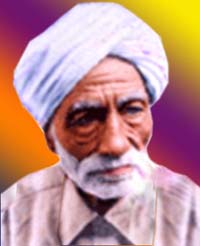
Pt. Roop Chand Joshi
Which Lal Kitab to refer?
Which one is the original Lal Kitab?
LalKitab is an ancient book of Hindu Mythology. This book was written in old Urdu. This book was founded on the lying skin of a dead man without any author name. It was founded in the caves of Tibet. This book then taken by the Persians and then pass to Iran. After sometime this book was translated in Urdu and Hindi. The remedies given in these books are effective in a hour.
The remedies in this book are very easy to complete and also a common man can perform it easily. Likewise in case of an afflicted sun, throwing a copper coin in flowing water is very useful. Like this there are many more easy, effective and instant remedies present in the book itself.
There are five editions of Lal Kitab written or compiled during the period of 1939 to 1952 by Pt. Roop Chand Joshi. Details are as follows -
1. Lal Kitab Ke Farman, 1939, 383 pages
2. Lal Kitab Ke Armaan, 1940, 280 pages
3. Lal Kitab third part, 1941, 428 pages (Also known as Gutka)
4. Lal Kitab Ke Farman, 1942, 384 pages
5. Lal Kitab, 1952, 1173 pages
The basic point behind the philosophy is finding simple, efficient and cost effective ways to bring greater fortune to the world.
LalKitab is the name given to all five books as a collection, but every book in the series has its own name. The books were originally crafted in the Urdu language and are dated back to sometime between 1939 and 1952.
No one knows who wrote the books or if they were all written by the same person. There is a lot of controversy over where the books originated from and who penned them, so I took it upon myself to seek out scholars and discuss these matters in depth.
First four editions were published by Sharma Girdhari Lal (cousin of Pt. Roop Chand), at Hazi Press, Lahore. Last edition i.e. 1952 edition was published at Narender Press, Delhi.
1. Lal Kitab Ke Farman, 1939
The Title of the book, transliteration of the contents as taken exactly from 1939 book:-
“Hatheli Ki Lakeeron se teva (tipda) Janm Kundli banaane aur zindagi ke poorey haalaat dekhney ke liye Samudrik Ki Lalkitab sn-1939”
हथेली की लकीरोँ से टेवा (टिपडा) जन्म कुडँली बनाने और ज़िन्दगी के पूरे हालात देखने के लिये समुद्रिक की लालकिताब – सन 1939
Translation of above in English can be
“Lalkitab 1939 of samudrik - To make the horoscope with the help of lines of Palm and to know the conditions of life."
The title of the first book is Lalkitab Ke Farmaan and it was originally published in Urdu in 1939 by Jahaazee Press in Lahore. In translation, the title means "the edicts of Lalkitab." The focus of this book is entirely on palmistry. It contains 383 pages and reveals 181 astrology rules known as Farmaans. These rules guide the art of Prediction.
The very basic guidelines of palmistry rely upon the shape of the palm and nails, but the rules covered in this book get into the shapes of the skull, forehead, feet and other parts of the body far removed from the hands. Each body part is connected to a planet and the book contained careful diagrams drawn out by the author.
2. Lal Kitab Ke Armaan, 1940
The Title of the book, transliteration of the contents as taken exactly from book:-
“Hatheli Ki Lakeeron se teva (tipda) Janm Kundli banaane aur zindagi ke poorey haalaat dekhney ke liye Samudrik Ki Lalkitab ke armaan sn-1940”
हथेली की लकीरोँ से टेवा (टिपडा) जन्म कुडँली बनाने और ज़िन्दगी के पूरे हालात देखने के लिये समुद्रिक की लालकिताब के अरमान – सन 1940
Translation of above in English can be
"Lalkitab ke armaan 1940 of samudrik - To make the horoscope with the help of lines of Palm and to know the conditions of life."
The second book in the series was titled Lal Kitab Ke Armaan, which translates out to "the desires of Lal Kitab." It was published a year after the first book and the rules to guide prediction were presented as desires, or Armaan. There are 181 Armaan presented throughout the book. While still covering palmistry, this author combines those principles with ideas of the horoscope and planetary alignments.
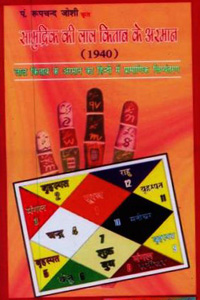
This is more of an advanced level book that introduces some new and quite unique concepts such as Masnooi Planets, or artificial planets. Other new ideas presented include the adult and minor horoscopes and the Moon Chart. The book also presents quite a few tables that can be used to determine benefic/melafic natures and the strength of the planets.
3. Lal Kitab third part (Gutka), 1941
The Title of the book, transliteration of the contents as taken exactly from book:-
“Hatheli Ki Lakeeron se teva (tipda) Janm Kundli banaane aur zindagi ke poorey haalaat dekhney ke liye Samudrik Ki Lalkitab teesra hissa sn-1941”
हथेली की लकीरोँ से टेवा (टिपडा) जन्म कुडँली बनाने और ज़िन्दगी के पूरे हालात देखने के लिये समुद्रिक की लालकिताब तीसरा हिस्सा – सन 1941
Translation of above in English can be
"Lalkitab teesra hissa 1941 based upon samudrik - To make the horoscope with the help of lines of Palm and to know the conditions of life."
In 1941 the third book in the Lil Kitab series came out in a compact, pocket sized book. It presents pictures of Gods and Goddesses that rule each of the planets. This even includes Mars Negative. The text was written in Urdu, but all in poetry.
The title of this book was TEESRA HISSA, which simply translates to the "third part." Each compact page contains only 15 lines of poetry, but some of the most crucial elements of El Kitab are revealed within these lines. This is the concept of progression with the Annual Chart and Varshphal.
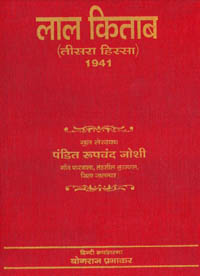
The remedies of Lal Qitab were designed to protect against enemies, though it was never intended to cause those enemies any harm. The goal is to remove obstacles that stand in the way of success and riches. It must be noted that Lal Kitab remedies cannot give anyone more fortune than is called for by Fate. It's all about achieving the maximum amount of success and fortune as possible.
4. Lal Kitab Ke Farman, 1942
The Title of the book, transliteration of the contents as taken exactly from book:-
“Hatheli Ki Lakeeron se teva (tipda) Janm Kundli banaane aur zindagi ke poorey haalaat dekhney ke liye ilam Samudrik Ki Lalkitab tarmeem shuda sn-1942”
हथेली की लकीरोँ से टेवा (टिपडा) जन्म कुडँली बनाने और ज़िन्दगी के पूरे हालात देखने के लिये इल्म समुद्रिक की लालकिताब तर्मीमशुदा – सन 1942
Translation of above in English shall be
"Corrected Lalkitab 1942 based upon samudrik - To make the horoscope with the help of lines of Palm and to know the conditions of life."
This book was published in 1942 under the name Tarmeen Shuda Lal Kitab, which translates out to "Modified Lal Kitab." This is the book most people find to be the most confusing and hard to understand. It includes the main components of all previous books. Hindi transliteration of 1942 edition by Pt. Beni Madhav Goswami is available from Durga Pocket Books.
5. Lal Kitab, 1952
The Title of the book, transliteration of the contents as taken exactly from book:-
“(Astrology Based upon Palmistry) - ilam Samudrik Ki buniyad per chalney waley Jyotish kee madad se haath rekha ke zariye darust kee huyi Janm Kundli se zindagi ke haalaat dekhney ke liye Lalkitab sn-1952”
(Astrology Based upon Palmistry)
इल्म समुद्रिक की बुनियाद पर चलने वाले ज्योतिष की मदद से हाथ रेखा के ज़रिये दुरुस्त की हुई जन्म कुडँली से ज़िन्दगी के हालात देखने के लिये लालकिताब – सन 1952
Translation of above in English can be
"(Astrology Based upon Palmistry) Lalkitab -1952 -To know the conditions of life with the help of the Jyotish that is based on Horoscope which is corrected with the help of palmistry. "
The final book in the Lal Kitab series was published in 1952. This is the book that is intended when you hear most people talk about LalKitab. Many people do not know about the other four books and believe this is all of Lal Kitab.
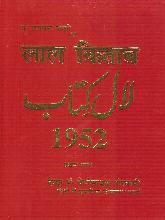
In this book you can find remedies for different problems. There is also a chapter on making predictions and tables with the relatives of different planets.
As you can see the last edition i.e. 1952 edition is the most exhaustive one and sufficient for start learning Lal Kitab. You can get more editions after becoming acquainted with Lal Kitab basics.
Translation of original Urdu editions are available in market. If you can read Urdu well, there can be nothing better than that. Go get the photocopies of original Urdu editions. But if you cannot, it becomes more difficult and depends upon which language you can read better.
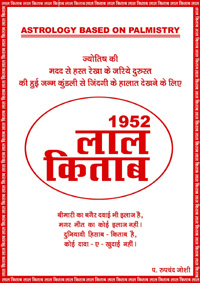
There are many new editions available on Lal Kitab. But few writers had changed the actual code of Lal Kitab. Writers had edited Lal Kitab by themselves and now it has been changed as compare to the original.
Before undergoing any Lal Kitab remedy we advice you to must consult a Lal Kitab experienced astrologer. This is very necessary to avoid adverse effect of Lal Kitab.
It is said that the solutions & remedies given by Lal Kitab are infallible. Some of them may look pretty weird especially in these modern times, but that is the way our religion is, inexplicable, occult yet overawing just by sheer magnitude of its diversity. That it has rightly been termed as" The Wonder Book" of Astrology.
The science of palmistry too has been explained in such an exquisite manner that each of the 42 divisions of the human brain have been related to the different houses of a man's birth chart in such a scientific manner that the sketch of the human brain reflects accurately on the lines of the palm.
Reading List for Lal Kitab System
(Important: Studying Lal Kitab would be meaningful only if you are a good scholar of Vedic Astrology.)
Books in Hindi
I would advise that you begin with
[1] ‘ Lal Kitab Jyotish – Prishthabhoomi aur Vyakhya’ - By Pt. Krishna Ashant
Pub : Shilalekh
4/32, Subhasgali, Vishwasnagar
Shahdara, Delhi – 110032
[2] ‘Trik Bhavano ki gatha’ - By Pt. Krishna Ashant and Amrita Preetam
Pub : Shilalekh
4/32, Subhasgali, Vishwasnagar
Shahdara, Delhi – 110032
After having read these two books move on to:
[1] Lal Kitab, teesra hissa [ 1941 edition ] also known as Gutka- Transliterated by Pt. Yograj Prabhakar
Published : Ravi Prabhakar,
Rahul Computers
1st floor, Master press building
Sheran wala Gate
Patiala
[2] ‘Arun Sanhita’ [ 1942 edition ]
Pub : Hare Krishna Trust
PO Box 123, Chandigarh 160017
[3] Arun Sanhita [ 1952 edition ]
Pub : Hare Krishna Trust
PO Box 123, Chandigarh 160017
You could also read the following book available in Hindi:
'Lal Kitab aur Kashta Nivaran’ - By Pt. Sumat Prasad
pub: Arun publishing House Pvt Ltd
SCO 49-51 Sector – 17C
Chandigarh – 160017
Lal Kitab 1939 edition (Lal Kitab ke Farmaan) - By Pt. Beni Madhav Goswami
Pub : Sagar Publications
72, Janpath, Ved Mansion
New Delhi 110001
Lal Kitab 1940 edition (Lal Kitab ke Armaan)
(i) By Pt. Beni Madhav Goswami
Published : Himachal Publications
123, Lajpat Nagar, Sahibabad,
UP 201005
(ii) By Umesh Sharma & Vashishtha
Distributors : Sagar Publications
72, Janpath, Ved Mansion
New Delhi 110001
Books in English:
[1] Start with Pt. Krishna Ashant’s book. It is a translation of the above book [the 1st one] in English.
Pub : Sagar Publications
72, Janpath, Ved Mansion
New Delhi 110001
[2] ‘ Lal Kitab’ - By Prof. U. C. Mahajan
Pub : Pustak Mahal
10-B Netaji Subhash Marg, Daryaganj
New Delhi – 110002
[3] ‘ Lal Kitab – system of progression and creative measure’ - By R. S. Chillar
Pub : Sagar Publications
72, Janpath, Ved Mansion
New Delhi 110001
[4] Lal Kitab 1952 ed translated in English - By Vashishtha & Goswami
Pub : Sagar Publications
72, Janpath, Ved Mansion
New Delhi 110001
Freqently Asked Questions About Lal Kitab
Question 1. What is the basis of the Lal Kitab?
There are quite a few astrology paddhatis prevalent in India today, they are all either elaborations or modifications upon the traditionally accepted Vedic astrology. Across all these paddhatis the basic parameters are the same. They differ either in approach or emphasis , the aim being the same in all cases.
Lal Kitab also draws its basics from the Vedic astrology, but it differs in approach or what the book calls grammar ; and the emphasis is not so much on predicting the future as on solving the problem of today , hence the importance of Upaya. The very first page of the book states the two purposes the Lal Kitab is meant for : (a ) to help remove the blockage in the flow of fortune's water and ( b ) to help erect an obstacle in the path of adversity thus saving the native from misery .
Therefore I believe that the Lal Kitab is as much a part of tradition as any other paddhati.
Q.2 When and how it came into existence ?
There are FIVE separate publications with varying length :
1939 edition of 383 pages, 1940ed of 284 pages;1941 ed of 428 pages, 1942ed of 384 pages and finally the1952ed of 1173 pages.
Surprisingly the name of the author has not been mentioned in any of these editions , instead they carry the name of the publisher, shri Girdhari Lal Sharma and his photograph. If it were an original work by any author, he definitely
would have got his name on it.
There are so many myths and legends about this book that it is really very difficult to sieve out the facts. These myths seem to have been woven around the book to make it look divine or some thing out of this world. Let me take them up one by one.
{ a ) that the book was written by Pt. Roop Chand Joshi. Some people , specially from Punjab , believe that the Lal Kitab was written, as an original work, by Pt. Roop Chand Joshi and he did not put his name as an author because he was in Government service under the British.
I do not understand why Joshi ji could not have put his name as an author. The British might have been against writing seditious material but not a book on astrology. Even if that being true he could have used his name in the 1952 edition , there were no British then nor he was in service any longer. Pt. Roop Chand Joshi was a very honest and a saintly person, he couldn’t have claimed something that was never his.
{ b }that the book was revealed in a dream . Never heard of dreams in installments and that too spreading over a period of twelve years. Because that is what alone could justify five publications spread over a period of 12 or 13 years. Not many takers for this fiction.
{ c } that the book was received as an ilham, kind of through a revelation, thus adding mystical sanctity to the book. If that were true the Lal Kitab would be the second book in human history to be revealed to the mankind , the first being the Quran. This was an effort to make it appear as sacrosanct so that there could be no criticism or scientific evaluation of the book. This belief has done more harm than good to the book. Well no body with a scientific frame of mind is going to believe that story either.
{ d } that this book was written by Arun the charioteer of Sun god. Later Ravan took it away to Lanka and from there it reached the middle east. It traveled back to India. This was an effort to get the book into the Samhita ranks , like other astrological samhitas in the name of rishis, while at the same time trying to justify the use of urdu and persian words. Not many people believe that either.
The fact is very simple : this is a book of astrology and that it was first published in 1939 by shri Girdhari Lal Sharma All subsequent publications are elaborations / explanations of the original. Every thing else about the book is irrelevant. All these books are available with some individuals or in the libraries.
Summarizing, all these stories about the book have been woven around by Lal Kitab semi-literates to hide their incompetence and instill in the minds of their clients an awe and reverence for the book. Reverence or faith in any system is built on it's efficiency rather than through such non-scientific humbug of trying to make the book appear as divine. Therefore I believe that this book is a documentation of the then prevalent thoughts and beliefs in the Northern Hills of India.
Q.3 Which Vedic parampara it comes from ?
Of course from the same parampara { tradition } as many other classics of Indian astrology have come from. You have to bear in mind that this book is a result of collective wisdom of a society which had lived in isolation of the northern hills for centuries. This tradition is still in use all the way from Kashmir to the Garhwal hills of Uttaranchal. In the Punjab it came to be known as Lal kitab , because of it's first documentation appeared in the red binding, As the societies living in isolation grow their own idiom , culture and points of references, similarly this tradition of astrology had also developed its own idiom and grammar. But the difference of idiom or the grammar does not make it come from any other parampara { tradition }. You know the growth of Indo-European languages.
Q 4 . Lal Kitab in the context of traditional Vedic Parampara?
Whether a text is in the Vedic tradition or not will largely depend on how we interpret the word Vedic and what all is included in the word vedic. Generally people think that vedic means ancient or of vedic kal • times of the veda. That is not true. Even some thing contemporary, of today, can be Vedic in its spirit. Therefore the word vedic represents far more and far beyond than the word is taken to mean. Those who think that vedic means of veda or some thing that had been written in sanskrit are taking a very myopic view of the word.
The word ‘vedic’ is to be understood in the Indian context. Therefore any thing dealing with India, and Indian values, ethos, psyche, traditions, belief systems, and the entire gambit of indian-ness would be included in the word Vedic. Evaluating the Lal Kitab on these premises it would be evident that the Lal Kitab is very Indian and very often insists and instructs people to follow a very pious traditional way of life. No other book on astrology lays such a great emphasis on the piety of life as does the Lal Kitab. Very often the book instructs not to drink, eat meat, tell lies, give false evidence etc and emphasizes on caring for the parents, elderly, young girls, loving ones brothers and sisters. Even goes on to insist on having good relationship with sasural [ in-laws ]. Not only human being, the Lal Kitab is filled with compassion for nature be it trees [ peepal, neem etc] , animals [ cow, serpent etc ] or insects [ bhuri chinti, ants ]
If all that above is not Indian or part of the centuries old Indian way of life, then what else it is.
Therefore I consider that the Lal Kitab is very much a part of the Vedic tradition and values followed in India for centuries.
I have not been able to find even a single instance in the Lal Kitab, that could suggest that the book is not Indian in terms of its content or form.
If some one thinks that a few urdu words here and there might mean foreign influence he is grossly mistaken. Urdu was a language of the literate in Punjab. Knowledge of this language never meant a foreign influence.
In his life time Pt Roopchand ji never claimed that Lal Kitab is a different system of astrology. He never claimed to have invented a new system. He never claimed that Lal Kitab is not a part of traditional Vedic astrology. He never intended the Lal Kitab to be treated as different from Vedic astrology.
After all, the book was meant for the astrologers of the day and common men alike. In the early 40s every astrologer who might have read these books would have belonged to the traditional Vedic astrology.
Therefore the Lal Kitab is downright Indian, upholding age old Indian values and traditions and therefore VEDIC.
Er. Rameshwar Prasad invites you to the Wonderful World of Lal Kitab (Red Book).
Engineer Rameshwar Prasad(B.Tech., M.Tech., P.G.D.C.A., P.G.D.M.) Vaastu International
|