VASTU SHASTRA
Vastu For Plot
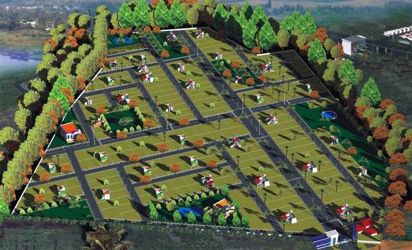
The selection of a plot is very important since the plot represents a fixed form, that will radiate positive as well as negative energies depending on it's location, orientation, shape, slope and soil quality. While selecting a plot these five major points are to be kept in mind.
Normally a Vaastu Expert is not involved at the time of buying a plot. But as a Vaastu Expert, I would suggest that it is good to involve one, at the time of selecting a plot, as his inputs could be very valuable in deciding the right Site. Generally, the points an Vaastu Expert will keep in mind while selecting a site, will by default be in accordance with Vaastu Shastra.
If you already own a plot for construction of house or office, you should still refer to the Vaastu Guidelines prescribed for the selection of suitable plot.
In the Selection of a plot, the following Vaastu Guidelines should be looked into, since most of these guidelines are based on scientific reasoning and few on common sense.
· VASTU GUIDELINES FOR PLOT LOCATION
· VASTU GUIDELINES FOR PLOT ORIENTATION
· VASTU GUIDELINES FOR PLOT SHAPE
· VASTU GUIDELINES FOR PLOT SOIL
· VASTU GUIDELINES FOR PLOT SLOPE
VAASTU GUIDELINES FOR PLOT LOCATION
Proper guidelines have been put fin Vaastu Shastra for the Selection of a plot. As Vaastu is a science, there is logic and reasoning behind every guideline. As a Vaastu Expert I have made an attempt to explain these guidelines rationally and scientifically. It is up to you to decide what you want to follow and what you don't.
WHAT IS THE BEST LOCATION OF A PLOT?
Peaceful, calm place with lot of greenery and good water source with good soil, for obvious reasons. The fertile soil is an indication of good soil for construction.
While purchasing a piece of land, it is a good idea to stand on the land and feel its vibration for a few moments. If you feel positive about it, consider buying the land. If not, it is probably not good for you. The Reasoning is that it is always advisable to trust your instinct but make sure you are not influenced by anything or anyone else, for good reasons.
Check the Plot history; it should be a good history. It is best to buy land where happy and successful people have lived. The natural reasoning behind the concept is totally psychologically, you will feel that a land where people were happy and prosperous; has good vibes or energy.
Check for the road adjacent to the plot. Plot with pathways on all four sides is considered the best. It ensures health, wealth, prosperity and happiness. The natural reasoning for the logic is because a Plot with roads on all four sides is not abutting any body's property and hence one can derive maximum lighting and ventilation from all four sides.
The next best option is a Plot with roads on the North or East. The reasoning I understand for it is that more light and air can enter from these sides in the mornings.
WHICH PLOTS ARE NOT GOOD?
It is advisable to avoid a haunted or dilapidated house. The Plot should not be purchased, if in the recent past someone has committed suicide on it, or if there have been several deaths over a period of a couple of months. You may psychologically feel uneasy if you happen to know of such a past.
Avoid purchasing a plot that has been sold under stress. Such Plots should be purchased only with caution and proper consultation with a Vaastu expert. One good reason is that you may feel psychologically unhappy and guilty, knowing that the Plot was sold out of helplessness and that the previous owner must be still holding onto it.
We have to avoid sites near a public place or buildings. The Plot should not be near or adjacent to any public place like temple, hospital, factory, school, college etc. Such places will constantly be crowded and noisy. But if they are at least 80 ft to 100 ft away, then the plot is acceptable.
We cannot live in an environment with foul smell. It is advisable to avoid sites near smelly places. The Plot should not be near a meat shop, workshop, leather tannery, laundry, shoe shop, dustbins, sewage drains etc. The bad smell emanating from these places will permeate the house permanently and naturally create a atmosphere in the house that is not suitable to live in.
If the plot is between large plots, it should be avoided. In such plots the owner of the smaller plot can construct only a much smaller house than the owners of the larger plots and thus, may subconsciously feel 'small' with respect to the neighbors. This can create a feeling of inferiority in the owner.
It is good to avoid plots with lot of cracks or too much wet soil. The cracks indicate dried up clayey soil and too wet soil also indicates clayey soil that does not allow the drainage of water. Such soil is not suitable for a building foundation as it will retain moisture and necessitate extra expenditure for water-proofing the foundation.
Strictly avoid Plots facing a T or Y intersection of roads. This is because you can see oncoming traffic and this may give you the nervousness feeling or lack of privacy. However, in some cases, as explained below, such plots are acceptable.
AS PER VAASTU SHASTRA, WHAT IS VEETHI SHOOL?
Plots facing a T or Y intersection, where roads or lanes run right into the face of the site from different directions are called Veethii (road) Shool (Arrows). Since it is difficult to comment on the different permutations and combinations of roads, oncoming roads, directions etc, that form the Veedi Shoolas, let us examine the basic considerations, in naming them as good, not bad, bad and very bad.
· East—NorthEast If the oncoming road is from the East, and hits the North-East part of the Plot, it is considered a good site.
· North—NorthEast If the oncoming road is from the North, and hits the North-East part of the Plot it is considered a good site.
· West —NorthWest If the oncoming road is from the West, and hits the North- West part of the Plot, it is considered as a not bad site.
· South—SouthEast If the oncoming road is from the South, and hits the South- East part of the Plot, it is considered as a not bad site.
· East — SouthEast If the oncoming road is from the East, and hits the South- East part of the Plot, it is considered a bad site.
· North — NorthWest If the oncoming road is from the North, and hits the North-West part of the Plot, it is considered a bad site.
· West — SouthWest If the oncoming road is from the West, and hits the South-West part of the Plot, it is considered a very bad site.
· South — SouthWest If the oncoming road is from the South, and hits the South-West part of the Plot, it is considered a very bad site.
CAN THE VEETHI SHOOL BE CORRECTED?
If your Plot is facing an intersection, (called a Veethi Shool), as you can see the oncoming traffic and people, this may give you the nervousness feeling or lack of privacy. In order to overcome this, you can use the corner of the plot that faces the intersection as a garage or car porch etc so that the main house is not facing the intersection. Or you could fence off that part and use it for some other purpose like a garden or outhouse etc.
VAASTU GUIDELINES FOR SITE SHAPE
As per Vaastu Shastra, the shape of the plot affects the well being of the inmates. It has been noted certain shape of plots have a good effect, while others shapes a bad effect and some plots can be used after making corrections to a suitable shape. As Vaastu is a science, there is logic and reasoning behind every guideline. As a Vaastu Expert, I have attempted to explain these guidelines rationally and scientifically, so that you can decide what you want to follow and what you don't.
SHAPES OF PLOT AND THEIR EFFECTS
Square plot
A plot with equal length and width is considered as an ideal site for construction. As per Vaastu, it ensures all round growth, prosperity and happiness. In ancient time, houses were designed around a central square courtyard, for better ventilation, a square plot was considered the most suitable.
Rectangle plot
A plot having the length and width in 1:2 ration are considered good. If the length faces north and width faces west, it would be considered more suitable. Such plots are considered to bestow good health, wealth and prosperity upon the residents. Like in a square site, it is easy to design a square or rectangle shaped house in such plot with extra space used for trees, outhouse etc. and hence is not wasted.
Triangular plot
The Triangle shaped plot is not good. Such sites are considered as sites where there will always be fear of fire.
Circular/Elliptical/Oval Plots
Such shapes are not considered good for construction of houses. According to Vaastu, such plots would bring bad luck to the owners.
Plots With more than 4 sides
Pentagon, Hexagon, Octagon shaped plots should be avoided for construction of house. People in such plots always live in fear.
Gou-mukhi plot
A plot that is narrow in the front and wide at the back is called Gou Mukhi. Such plot is considered auspicious for residential purpose. Such plots bring prosperity to the house owners.
Simha-mukhi plot
A plot that is wide in the front or entrance and narrow at the back is known as Simha Mukhi plot. Such plots are considered inauspicious for residential purpose but are suitable for commercial purpose.
Plots with corners cut
Plots with a missing corner should not be purchased for any reason. If you must, then do so with proper consultation of an Expert Vaastu Shastri. Plots with cut corners are considered inauspicious.
Plots with projections or extensions
The plots with extension in the North or East or North-East are considered good. Other extensions are considered as inauspicious. Plots with extensions in the North-West, South-East or South-West are not considered good, they bring bad luck to the owners.
Vastu Tips for Plot
Based on shape:
- The most ideal shapes of plots to have been Square and Rectangular.
Based on the position of the plot:
- There must be no neighboring cemeteries, crematoria, mausoleums, or other burial sites.
- Avoid the land directly across from a hospital, nursing home, or religious institution.
- Vastu considers a blockage of positive energy entering the smaller space if the real-estate property has two large plots or buildings on the two surrounding sides. Misfortune and loss are attracted to these schemes.
- Avoid putting a waste dump or sewage near your commercial or residential property.
- When hills, mountains, elevated terrain, taller structures, or trees are present in the west or southwest direction of the house, it is considered lucky.
Based on per structure of the plot:
- A land with roads on all four sides is considered lucky by Vastu for commercial and residential reasons.
- According to Vastu, a vacant plot of land in the northeast or north direction is auspicious.
- Land that faces north or east and has a lake, canal, river or other body of water is considered lucky and auspicious.
VASTU GUIDELINES FOR SITE ORIENTATION
Vaastu Shastra lays down guidelines to aid you in the selection of a plot with the ideal direction. As Vaastu is a science, there is logic and reasoning behind every guideline. As a Vaastu Expert, I have attempted to explain these guidelines rationally and scientifically, so that you can decide what you want to follow and what you don't.
WHICH IS THE BEST DIRECTION FOR A PLOT?
In ancient text of Vaastu guidelines to aid in the Selection of a plot with the ideal Orientation are based on Common sense, scientific reasoning and logic. As per Vaastu:
All directions are considered good and each has its own advantages. The only reason I understand is; in any city or town, there are roads in all four directions and naturally there have to be houses on both sides of the roads. Also, the city looks more aesthetic if there are houses in all the four directions. Hence, according to Vaastu, all plots are considered good.
East facing Plot is good for scholars, philosophers, priests, professors, teachers etc. The Logic- East (morning sun rays) is considered the source of enlightenment. North facing plot is good for those in power, administration and those who work for government. South facing plot is good for business class and for those who work in business organizations at management level. West facing plot is more suitable for those who provide supporting services to the society.
The reason why Vaastu attributes each direction to a different class of people is because in ancient times, Indian society was divided into four classes of people, based on their occupations. But gradually these classes became castes and there was very little social mixing between the castes and so people of each caste preferred being with their own people. Hence their homes were grouped together.
VAASTU GUIDELINES FOR SITE SOIL
In ancient Vaastu text proper guidelines have been prescribed to aid you in the selection of a plot or site with the ideal soil type. As Vaastu is a science, there is logic and reasoning behind every guideline. As a Vaastu Expert, I have attempted to explain these guidelines rationally and scientifically, so that you can decide what you want to follow and what you don't.
ACCORDING TO VASTU SHASTRA, WHAT IS THE IDEAL TYPE OF SOIL IN A SITE?
To construct a building for any purpose, land is required. And it is a fact the land has not been previously not allocated for the same. It has to be some or the other kind of site that has to be used. It should be correctly noted for what purpose the land was being used previously.
While purchasing land, it is ideal to buy a piece of land that is most suitable for cultivation i.e., where the vegetation can grow. There are different types of soil based on the colour- brick red, dark brown, white, red, yellow, black etc. Generally the soil which is good for cultivation like red, brick red, brown, yellow soil etc is also good for the foundation of a building. Whereas, black and clayey soil which is not good for cultivation is also not good for buildings as it retains water and can cause dampness to the foundation.
It is advised to avoid a site with black and clayey soil. The Reason being, the black soil indicates soil that retains water and doesn't allow good drainage. It is best to avoid such a site because it will require special kind of foundation and water-proofing which will cost many time more than the usual foundation.
Again avoid rocky piece of land for construction purpose. Land with too many rocks and thorny trees is not considered good. This is because it may be an indication that there is rock below which will have to be blasted out before laying the foundation, causing unexpected expenditure.
A land with lot of worms should be avoided. This may be an indication that the soil is very loose and will not support the foundation well.
Er. Rameshwar Prasad invites you to the Wonderful World of Vastu Shastra
Engineer Rameshwar Prasad(B.Tech., M.Tech., P.G.D.C.A., P.G.D.M.) Vaastu International
|